Showing posts with label Spotlight. Show all posts

07 January 2011

Spotlight on...Tracy Miller

Buzz, Buzz, Buzz, 2006-2010, Oil on Canvas

The first thing that hits me about your work is the color palette which includes a lot of candy colors. Are these your favorite colors? 
I'm attracted to colors that pop, and the brightest ones are the ones that continue to appear again and again.

What is your studio routine?  Do you have several paintings/projects going on at once? 
Usually, there are about a dozen paintings of various sizes in the studio. They get turned upside down and rotated over time until paint accumulates.


Pig, 2009, Oil on canvas


Do you work from still lives, images, collages? 
I do sometimes look at still lives--flowers, cookbooks, table cloths--but mostly paint without looking at anything.

Aside from the relevant subject matter, where do you find inspiration?
Visiting landscapes with real horizon lines, bakeries, riding in cabs, wandering through the Met, walking in NYC.

Did you always want to be an artist and how has your career developed?
When I was 5, I received two artist smocks for my birthday and knew I wanted to be an artist. When I was an undergraduate and thought it was too impractical to take a painting class, everything clicked while painting 5 yellow cars outside the window.

What is the most interesting, engaging part of making your work?
Being in the middle of the mess of paintings and seeing colors and textures pop with surprise is where it all makes sense.

Anything about your work that you don't enjoy doing but you have to do it to get to the good stuff?
If someone else could wash my brushes and stretch canvas, I'd be thrilled.


 Dolly Mountain, 2009, Oil on Canvas

 
What are you working on now?
More food paintings.

What philosophy or words do you live? 
I try not to worry too much about getting everything done everyday but know that over time it will all work out. It helps to keep the panic away.

Visit Tracy's website and her upcoming show at Feature Inc. in NYC from January 19 through February 13, 2011.

Thanks Tracy!

25 May 2010

Spotlight on... Deborah Simon

First, how did you start doing the type of work that you do....it's such an interesting combination of art and animal science.... 
I’ve always loved animals and can remember drawing them since I was about four. I stopped in college and it took until after grad school to come back to animals – I guess I thought to be a serious artist, you had to focus on humans.

I’ve also always had animals around and have worked in veterinary clinics and at the Bronx Zoo. I never had the desire to anthropomorphize animals. I find them fascinating as they are – I try to understand what they are doing and why from the animal’s perspective - and want to present them on their own terms which somehow all blends with the art to make for a rather surreal but scientific approach to my work. I often have to remind myself to sacrifice accuracy for the sake of aesthetics.

You have an incredible aptitude for the anatomy and detail in creating your creatures- are you constantly studying anatomy? 
I’ve never studied anatomy –  not a single class. I’m just bent that way.
 
What kinds of materials do you use and where do you find them?  
The sculptures are made out of wire armature, foam, Sculpey and faux fur. The fur is the important part and I’m always on the lookout for any faux fur that that’s realistic. It’s amazing what’s often in the bargain bin – I found fur that looks just like a spotted hyena, which probably explains why it was there to begin with.  Once I start sculpting the face, I order glass eyes from a taxidermy supplier.
 
Can you describe the process of creating your work, where do you begin? 
Usually I come up with the idea and let it sit in my mind for a couple of months, refining it and seeing if I’m interested enough to sustain a long term project. After that the fur dictates what I work on to some extent. Sometimes I’ll find something that’s perfect for an opossum or a hyena and then I’ll make it. Other times I have a species in mind and go hunting for the fur which can become quite difficult. Finding black and white fur that was exactly the same except for the color wound up taking several years, which I found surprising – who would think finding plain black and plain white fur would be so hard.
I also try to study the animal in person if I can at a zoo or sanctuary. I’ll sketch and photograph them and most importantly get to know how they behave. I find that all of the knowledge goes into a piece and the ones that are the most successful are the ones where I knew the animal best. 


Can you talk about your upcoming project, Coyote Pursues?  Have you made puppets before?  How is it to create puppets as opposed to still figures. 
Coyote Pursues is a multi-media performance of marionettes, video and music that will portray two coyotes living in an austere world newly bereft of people.  A friend, Matt Reeck gave me a collection of his “fairy tales” and asked me to illustrate them. They were all short – some only one sentence – and all very visual. I thought they would work as puppet shows. I love building scale models and had thought the fairy tales needed to be three dimensional, but moving, which lead me to puppets and to St. Ann’s Warehouse’s Puppet Lab which we are now in. The Lab is a nine month workshop culminating in three performances at St. Ann’s June 23 – 27.

My only prior experience with puppets was a chicken marionette I made as a child. It was a kit that I painstakingly put together, gluing all the feathers in one by one, and the day I finished it, my dog who was a puppy and teething, chewed the entire puppet up while I was grocery shopping with my mom.
The coyote marionettes were very hard for me to make. I was trying to keep them as realistic as possible and figure out how to get a realistic range of motion and make them easy to use. I would spend weeks trying to figure out how to get the movements I want and would end up feeling like a medieval engineer – after much trial and error I would find a method that worked and have no idea why. In the end they have a pretty wide range of movements and although the process was incredibly challenging, it was also very satisfying.

What is your studio routine? 
I get up in the morning and am in the studio around 9:30. I’ll take a break for lunch and then work until around 7:30 or so. I’ll put on NPR and my rabbit will come in, play around for a bit and then go to sleep under my stool. I tend to get tunnel vision and can work without stopping for hours.

On your website, you mention working at the Zoo, Do you do exhibit design there or what do you do? 
I’m no longer with the zoo, but when I was there, I designed and built exhibits for the animals. This could be anything from making a drain cover look like a rock to the aardvark exhibit with sprayed concrete termite mounds, life support systems, heated burrows and mural work.

What do you do with your work once it's finished and has been exhibited?   
Find a corner of my studio to store it in and wonder why on earth I need to sculpt.


What words or philosophy do you live by? 
I don’t really live by any philosophy – it would put constraints on an evolving world and may not be applicable to a given situation.


Check out Deborah Simon's marionettes in Coyote Pursues
June 23 - 27, 2010
See more of Deborah Simon's artwork.

25 February 2010

Spotlight on.....Dorothy Robinson


I saw on your resume that you studied Geography-- and I can see that interest in your paintings. Can you talk a little bit about subject matter- and how you arrived at the subject of your work.
My interest in landscape is probably linked to family background. Both sides of my family were farmers for many generations, but, in response to post-WWII economic changes, migrated to urban centers during my childhood. I think what I inherited from this is an intense awareness of the physical environment, as well as a need to address the condition of fragmentation and loss that seems to accompany upheaval and change.

My initial interest in studying geography as an undergraduate stemmed from a need to avoid taking Chem 1A, a course that stood between me and any serious study of geology, physics and botany, all of which I found fascinating, at least in theory. But as it turned out, studying geography gave me exactly what I needed - a broad overview of the various forces that interact to create a landscape.

A few years after I began painting, landscapes seemed to emerge on their own accord from randomly applied fields of color, but my fractured sense of place kept them from resolving into a single environment. Eventually, I realized that what I was trying to do was to make several different environments, conflicting views and the passage of time into a single unified landscape.


What artists, books, or other sources do you look to for ideas and inspiration?
Art that most inspires me is probably outsider art, as it comes from such an intense need. But I look at all sorts of painters for inspiration. Lately it's been Robert Colescott, who died last year. I love his compositions and kind of brutal sense of humor.

I also like to read geology- and physics-for-dummies type of books for ideas and inspiration, as they help in trying to grasp the fundamental principles that govern space, time and the physical environment. And I love looking at maps and satellite imagery.

Painting at residency programs has also been a great source of inspiration; the experience of unfamiliar environments converging on my senses seems to shake up old habits and open up new possibilities.

Did you always want to be an artist? and how did your career develop when you were first starting out?
It did not occur to me to make art until my early 30s, when a friend encouraged me to join her weekly drawing group. Something clicked during my first session, and from that point on, art became the organizing principle of my life. My career has unfolded more or less in step with the development of my work. As the work has gotten better, more opportunities have come up.


What is the most interesting and engaging part about making your work?
The seemingly simple act of moving paint around a surface can be completely engaging. It shows me that the conscious mind is just a fraction of a much larger thing that we can’t even begin to comprehend. I need that, because I tend to feel trapped by the demands of day-to-day life, and bored with a lot of what passes for entertainment and pleasure. Painting releases me from that; it has a mind of its own, its own ideas about what it wants to do.

What do you least enjoy about making your work--but you've gotta do it?

What can I say - oil paint is messy. I'm messy. Cleaning is essential.

What is your studio routine?
I try to draw every day to clear my mind. The drawings often reflect the sort of day I'm having - the background noise of day-to-day life and its minor irritations. Then I try to read something about landscapes - right now it's John McPhee’s Annals of the Former World – and after that, I'm usually ready to paint.


What are you working on now?
I’m working on paintings inspired by my interest in plate tectonics. The theory goes something like this: the Earth’s crust is broken up into a series of interlocking plates. The plates are themselves set in motion by the continual upwelling of molten material from the Earth’s core, as well as the gravitational pull exerted by the moon. Inevitably, these fragments collide and grind against each other, or tear apart and separate. There is something about this theory that resonates symbolically with my life experience as well as the prevailing cultural and political climate, and continues to shape my work.

What do you enjoy doing when you're not in the studio?
As a painter of landscape, I feel like I should be a dedicated hiker and/or plein air painter. Alas, I’m not. I do like to walk, though, to nowhere in particular. I just enjoy moving through space and time, looking at things.

What philosophy or words do you live by?
My philosophy resembles the theory of plate tectonics. The human condition mirrors that of the Earth’s crust — fragmented and constantly in motion, driven by forces beyond our control. Cheerful, huh? I’ve managed to extract a small amount of wisdom from the Buddhists that brings me peace of mind. Detachment. Acceptance. Meditation. Breathe.


Dorothy Robinson’s paintings have been featured in solo and group exhibitions in museums and galleries, including the Berkeley Art Museum, Williamsburg's Slate Gallery and at Edward Thorp Gallery in Chelsea. She has a studio at the Elizabeth Foundation for the Arts in New York City, and received a Pollock Krasner award in 2008. To learn more about Dorothy, please visit her website.

22 November 2009

Spotlight on.....Valerie Hegarty

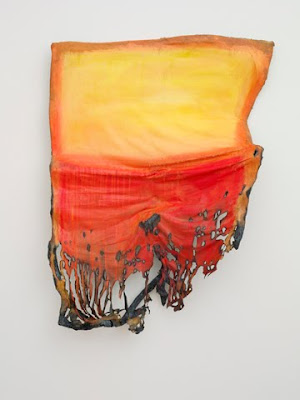
[Rothko Sunset, 2007]

Can you walk me through how a piece comes into being from idea to finished piece.

Let’s see, right now I’m reading “What Painting Is?” by James Elkins and its generating this idea that I want to take various paintings from art history and have them all be melting together, both breaking back down into their chemical makeup, or look like it anyway, then all the color and material mixing together and starting to take a new form, as if the ultimate meaning of the images can be gleaned out by melting and fusing them together. I can’t really picture what this will look like in my head so I’ll usually start with photocopying images from books and cutting and pasting them together and drawing doodles and then the answer might lie more in the process. I can plan which images and how they collide, but I probably won’t come up with the new form it creates until I start working and it starts to form through the process. That is how the work is going these days anyway. Sometimes it’s much more preplanned. Like I had an idea to make a huge early American realist landscape painting being attacked by a woodpecker who was tricked by the realism. But also have it look like machine gunfire blasted the painting from farther away when you see it at first glance and don’t notice the woodpecker. Woodpeckers look for infestations so it implies a level of self-destruction within the American landscape. This was more straight-forward to execute although the process of making the piece added more richness. I got the idea from 2 articles in a newspaper on the same page: there was an article on the war in Iraq and a photo of a tank in Iraq shot through with holes like swiss cheese and below the image was another article on a sighting of a rare woodpecker and it gave me the idea.


[Among the Sierras with Woodpecker, 2005]

How did you arrive at the subject matter of your work?
It’s been a long windy process, that seems to circle around continually, like the snake eating its tail. I’ve always had a strong interest in place, memory, artifact, and make-believe. I grew up in a colonial style house that was built in the late 60s, so we had some faux early American artifacts like a rifle over the fireplace, bedwarmer, Paul Revere tea set and American-ish landscape paintings on the walls, along with framed reproductions of famous paintings that were made to look like real paintings. I loved thinking about these scenes and artifacts as my personal history even though it wasn’t true. My father would always point at the large beams in the ceiling and explain to people how they were cleverly made with many 2x4s stacked together and roughed up so they look just like the original beams would have. I think I hooked onto his delight in the clever copy. We were also never allowed to tack anything to the walls of our bedroom or bend or write on pages in books. I shared a bedroom with my sister and the furniture set was too large for the room so we were packed in there and couldn’t even shut the door. I’d just lie on the bed and imagine writing in all the books and on the walls and breaking the furniture into smaller pieces so we had more room. I think making art and making paintings and breaking them and trying to transform them comes from this strong impulse to touch forbidden things and explore them with a creative passion. To sort of eek out the essence of the materials and meaning. I remember once my sister made a human-like head of Kleenex and glue that looked like a real head and she would carry it around with her on a stick. One day when she left it unattended, our dog attacked it and we found it strewn all over the house and I thought it was brilliant. My father’s a doctor so we would hear about a lot of gory accidents from his reports back from the emergency room so I have a strong sense of the fragility of things and like the rest of my family, I developed a dark sense of humor as a way to cope with the anxiety generated by hearing about bodies falling apart.

[George Washington Shipwrecked, 2007]

How do you decide what materials to work with-- how to turn a 2-d painting into a 3-d sculpture that comes off the wall?
I use materials that are easy for me to manipulate, so they tend to be materials I learned to use as a kid, like cardboard, papermache, tape, wood, wire, glue. Now I’m working on a public project for the Highline that has to be outdoors so I’m working with a fabricator that is translating the work into the best materials for that such as aluminum rod, fiberglass, and epoxy.

What artists, books, or other sources do you look to for ideas and inspiration?

I find inspiration in Magical Realist writers like Octavio Paz and Jose Saramago. How they start the reader off on a totally probably path of the story and somehow when the unbelievable starts to happen, it seems probable. These transitions are beautiful and strange. Oh and I’ve been thinking about Magritte, his way of showing the concealed and the revealed at the same time, these impossible juxtapositions that he makes seem possible and the poetry in the “seaming” together of contrasts. Lately for inspiration I’ve been looking at books on crystals and minerals, bonsai, images of the earth from space, and images of space from the hubble telescope. I also went and looked at the Georgia O’Keefe abstraction show the other day to generate ideas for these abstract forms I want to make based on atmospheric conditions. I’m interested in the sublime in painting and how to transform the 2-d painting into a more abstract form and image, making the transformation of the painting itself a sublime occurrence.

[Niagara Falls, 2007]

Did you always want to be an artist? and how did your career develop when you were first starting out?
I remember when I was really young, I wrote down two career options for myself. One was an artist and one was a writer. I remember practicing my signature on the paper and then putting it away in a drawer. I still think about being a writer. I used to make drawings, paintings, and crafty projects all the time when I was a kid, in addition to writing detective/murder mysteries usually involving ESP. I didn’t really take art in high school because I figured artists must be REALLY good, but in college I took an art class as a lark my junior year and switched my major to studio art much to my parents dismay who were paying my tuition. I then went and did another undergrad in illustration in San Francisco, did that for a bit and didn’t like it and finally went back to graduate school for an MFA at the Art Institute of Chicago. When I graduated I moved to NY and just started applying for everything and was lucky that I got presented many opportunities for free studio space and site-specific installations. I was nominated for a grant and a gallery saw the list of nominees and took an interest in my work. They (Guild & Greyshkul) then offered me a solo show and things went well and we worked together for about 4 years until they closed this past January. Lately I’ve been thinking about wanting to be a writer again and have been writing my own magical realist short stories that tend to veer into the gothic. One story is sort of a retake on Frankenstein, where the artist cuts off her arm in order to have it keep producing in the studio at night while she goes home and sleeps. As you can imagine, things go awry quickly.

What is the most interesting and engaging part about making your work?

I love when I am in the middle of it and things seem to take shape in front of my own eyes, as if someone else was doing it. It’s such an exciting feeling when it seems as if I’m discovering and creating something totally new for myself.

[Unearthed, 2008]

What do you least enjoy about making your work--but you've gotta do it?
Plenty of time the work seems like pure drudgery, once the idea and form is set and there is just straight execution. If I had more money I’d get a team of assistants to do all the labor. And have them clean and organize my studio, it tends to be in disarray most of the time. I also don’t enjoy figuring out and buying materials, packing and shipping work, and trying to keep galleries and curators from figuring out my ideas and work that has changed since we last spoke about the show.

[Valerie in her studio]

What is your studio routine? several project at once? Do you spend time doing research, collecting source materials and ideas?
My studio routine is all over the place. There’s always times when I’m sketching ideas, or looking through and reading books, making models, sleeping, trying to organize the mess I made the day before, talking to whoever is sitting by the refrigerator, picking through the garbage for something I regretted throwing away, etc. There are usually a few projects going on at once and I will work back and forth, trying to give a piece a rest when I can’t seem to figure it out.

What projects are you working on now?
I just finished up some work for a show in Portugal in the spring and finished a public project for the Highline that was installed last week. And I am just about to get started on work for my first solo show at my new gallery in the lower east side, Nicelle Beauchene Gallery.

[Autumn on the Hudson Valley with Branches, installed on the High Line in NYC, 2009]

What do you enjoy doing when you're not in the studio? I like to read Buddhist self-help books, hang out with friends for dinner and coffee, go see shows, see movies, walk around Manhattan and look at the big buildings, visit family in Boston and Maine, and other non-exceptional things. I do some teaching with kids in Brooklyn and just started volunteering at a hospital drawing portraits in pediatrics.


What philosophy or words do you live by? Lately when things get rough, I remember hearing somewhere “most people quit right before they are going to make a breakthrough." And “be grateful everyday."

Valerie has had solo exhibitions at Museum 52 in London, England, the Museum of Contemporary Art Chicago and Guild & Greyshkul Gallery in New York, among others. Her many group exhibitions in New York City include shows at the Brooklyn Museum of Art, Artists Space, The Drawing Center, White Columns and PS1. She is the recipient of awards from the Rema Hort Mann Foundation, the Louis Comfort Tiffany Foundation, and the Illinois Art Council. Additionally, she has participated in residencies at the Marie Walsh Sharpe Space Program, PS 122 Space Program, and Smack Mellon Artist’s Studio Residency, among others. Hegarty holds a MFA from the School of the Art Institute of Chicago, a BFA from San Francisco’s Academy of Art College, and a BA from Middlebury College.

Valerie Hegarty is represented by:
Nicelle Beauchene in NY and Museum 52 in London

View more information on Valerie's installation on the High Line in NYC.

05 August 2009

Spotlight on...Justine Reyes


Untitled, Vanitas, 2009, C-Print

You have done a lot of traveling throughout the world- and have been doing so since college, are there certain places that have affected you and your creativity above others?

My time in Italy and traveling throughout Africa has had a profound effect on me. I love seeking out craft and artisan specialties when I’m traveling. I relearned how to crochet from my Amai in Zimbabwe and was encouraged to really learn new patterns and techniques by my friend’s stepmother in Tanzania. I studied weaving, batik and soft sculpture at Fuji Studios in Florence in 1998 and 2000. It was there that I began thinking about ways to use traditional crafts in my contemporary art making practice.

Can you talk about your travels in general- and what traveling means to you?
Traveling is figuring out the world and figuring out my place in it.

What are you currently working on?
I am currently working on a few new bodies of work. I began a still life series while in residence at the Center for Photography at Woodstock this fall. This series is inspired by Dutch Vanitas paintings and incorporates personal objects of my own as well as objects that belonged to my grandmother. Pairing these objects together speaks to memory and the legacy that one leaves behind. Both the decomposition of the natural (rotting fruit and wilting flowers) and the break down of the man-made objects, reference the physical body and mortality. These objects bear witness to a spiritual trace or imprint that is left behind or residual.

I am also continuing my Away from Home series where I photograph my Mom and Uncle in hotel rooms around the world and I’m still shooting my Guayabera Series and will be crocheting my installation until this war finally ends.


Al, Barcelona, Away From Home, 2008, C-Print

You have worked on a few different bodies of work--images of different objects, your Uncle's t-shirts, the suitcases, how does one project transition into the next? What is your train of thought while you are making your work?
My process is very intuitive and each project builds organically. Much of my work demonstrates the power of objects to bear witness to intangible ideas and emotional truths and employs the iconography and symbols of common everyday objects as a means of communicating shared
experiences. The death of my uncle profoundly impacted me and has in large part brought me to my most current bodies of work, many of which include my family, the idea of leaving and returning home, and the longing to hold on to things that are ephemeral and transitory in nature.

What Remains, 2007, C-Print

What is your dream project?
I’d really like to be able to take my Mom and Uncle Al all over the world for my Away from Home series. This year we are planning to go to Morocco. Time and money are the biggest obstacles but I’m excited to see this work grow and develop over time.

Do you collect source materials? and If so, what?
I collect everything. Seriously. I have a collection of candy wrappers and boxes and even have some framed in shadow boxes. I really like packaging, especially things from foreign countries. I also have binders of images that I tear from Art Forum, Art in America and other magazines of work that I love. Linda Connor actually had us do this in school and it really helps me remember the names and work of other artists.

Untitled, Vanitas, 2009, C-Print

How does your art practice fit into your daily life? or how do you balance your art and your life?
It seems like everything I do is art related or at least 95%. Its good to have a job you love so you don’t feel bad when you’re working all the time. Finding balance is an endless goal.

How do you get through artist's block?
I am always working on projects simultaneously so I usually have too many ideas and not enough time but if I get blocked I would read more and revisit art history for inspiration or go running.

Mom, Barcelona, Away From Home, 2008, C-Print

What words and/or philosophy do you live by?
I don’t have a personal philosophy. I’m just living, making mistakes and trying to learn and grow.

Thank you Justine!!

Justine Reyes lives and works in New York. Reyes' work revolves around issues of identity, history and time; and our relationship to these themes in a post 9/11 world. Using photography and installation, she examines family, the idea of leaving and returning home, and the longing to hold on to things that are ephemeral and transitory in nature. she received her MFA from the San Francisco Art Institute in 2004 and her BFA from Syracuse University in 2000.

Reyes’s recent work: Guayabera Series was included in Queens International 4 at The Queens Museum of Art. She was also recently awarded the Individual Artist Initiative (IAI) from the Queens Council on the Arts.

12 July 2009

Spotlight on.....Karen Yasinsky


"I Choose Darkness," 2009, stop-motion puppet animation, 8.5 minutes

What projects are you currently working on?
I just finished a drawing animation based on a scene from Robert Bresson's film "Au Hasard Balthazar." It is a close-up profile of the character Marie speaking. She looks sad and earnest. Or rather blank. I rotoscoped it which involved saving the scene as a series of jpegs, 30 images per second and then drawing each image using a light box. There are several interruptions to her speaking when the image changes. It moves down and off the page then comes back from the top; it becomes an image made of small squares then changes colors; and finally the squares show the negative images. There are also series when every other image is a different color, moving through the spectrum, with the original black line on white in between. This creates a strobing effect. The sound, by Snacks (Tom Boram and Dan Breen) uses a piece by Brahms, static sounds; tremolo and other sounds to match these interruptions. Brahms plays while she calmly speaks but only partial sounds come out of her mouth. She doesn't communicate. My goal was to make something sweet, sincere and aggressive. I wanted the formal manipulations to work on the viewer in a physical way while the actual image spoke to the viewer in an emotional way. This is the first time I really put this into words, so, it's all a little green. Next I will begin a puppet animation with a character based on Elliott Gould from "California Split" by Robert Altman. But this character will be subject to my own version of Godardian influence.

Can you discuss the process of creating your work; is it a multi step process? Do you work in a studio?
First I have the idea and I don't really know what I will do with it until I start working. Animation is such a slow process that it allows for much rumination while in the process. With the puppet animation, I create the models, their clothing and simple sets. While doing this I am figuring out their personalities and what will begin the animation. This will involve gestures and maybe just one interaction. Then, when I'm animating, I can think of many outcomes to the scene I am working on. I can become the characters, get into their little heads and make decisions for them. I suppose it's like fiction writing. My studio is a room in my house that is totally private. I can work at any time which really suits me. I don't like to leave home to work.


"Marie," 2009, drawing animation, 3.5 minutes looped

How much research goes into your work and what form does the research take, (reading stories, looking at animation, looking at images, going to the library?)
For the past few years, my animations have been based on films I love which do something in my memory which makes me want to work with the characters and something that was very powerful in my reading of the film. So I will watch that film a lot, listen to it and collect stills from it. For my Elliott Gould character, I'm not so interested in the story told in the film but in his gestures and physical performance. I don't look at animation for my own work but the sound work in old cartoons is useful. Robert Breer's work inspired one drawing animation I did, but my pacing is so slow that it was my animation with Breerian hiccups. I read a lot of stories and novels and images and ideas from them find their way into my work but it's not purposeful research.

Do you collect source material? If so, what?
Film stills, old wallpaper and fabric patterns for drawings.

"Enough to Drive You Mad," 2009, Stop-motion drawing animation, 4 minutes

What inspires you?
Humans as seen through film and literature. Their gestures, oddities and the difficulty and self-consciousness of being human. Film language is a great inspiration and sounds-how they can manipulate an image. How a scene is framed; the movement and rhythm within the frame and within the sequence; light and color. I'm very interested in what we see and how we perceive at 24 frames per second-film time.

Do you have a daily ritual that gets you ready to go and do your work?
I have a 5-year-old son that makes me appreciate every free minute I have for my work.

What do you enjoy doing when you are not creating art?
I swim, read and cook.

How do you work through artist's block?
Since the animation process is so slow, I don't have any blocks. While I'm finishing an animation I already know what I want to do next. Often I will work on drawings at the same time so it's great to have a few things going on at the same time. There's also my 5 year old. He keeps me in the present tense, which is a great way to work and live.

How do you juggle exhibition scheduling, applying for grants, making new work, and typical life responsibilities- doing laundry, grocery shopping, etc.....
At times I don't sleep much. When I have a deadline for my work I will work nights when I have the longest stretch of uninterrupted time. I also don't often answer the phone and just prioritize. I don't apply for enough grants and regarding exhibitions, I just hope they keep materializing. I do need to make time to create a website. But stuff like this and cleaning fall by the wayside. I would always rather draw.

What artists or other people have inspired you along the way?
Bruce Nauman is huge. His work really cuts to the psychological discomfort of aspects of being human. But it hits you often in a sensory way so you have to translate the physical feeling. I saw a Bruce McClure show recently that floored me. It was aggressive and mesmerizing but filled me with joy. There was no emotional content so that was left to the viewer. My favorite filmmakers who inspire me are Yasujiro Ozu, Robert Bresson and David Lynch. Many of the great silent films inspire me. Silent Light by Carlos Reygadas was a recent strong buzzing light in my brain as were the stories of Robert Walser.

Marie and Magoo, 2008, Graphite, ink, gouache and colored pencil on paper, 18.25 x 14.25 inches

What words or philosophy do you live by?
I am a pleasure seeker and I take pleasure in my work and family-so I feel incredibly lucky. I feel like we humans are all tiny dots in the huge scheme of things and in this realization, there is freedom and beauty. I also like to think about the definition of beauty since it's important to me.
Thanks Karen!

Karen Yasinsky lives and works in Baltimore, MD. Karen is an internationally exhibited artist working in film, animation, puppetry and drawing. She received her MFA from Yale University in Painting, and studied at the NY Studio School.
For more information and to see more of her work, visit Mireille Mosler Ltd. or the Baker Artist Awards.

22 June 2009

Spotlight on....Isidro Blasco

(Shanghai Planet, 2008)

Your work combines elements of photography, collage and sculpture and I love how it plays with indoor/outdoor space and architectural space both within the photographs and as completed works on exhibit.... Can you talk about how you started working in this way?
At first I was just playing around with light and shapes projected on the wall. Mostly square shapes; and I was interested in building a second layer of that square, just hanging on the wall, just in front. It was sort of like illuminating that part of the room, a corner for example; and having that section built up. And when you turn the light off, you have this shape built right there, and it becomes an object. And you can add to this one, others around it, until you fill up the whole room. And some times I did just that, the whole space with structures overlapping. It was a lot of fun. I did one at PS1 as part of the defunct program ‘Special Projects’ in 2000. And I used only two very large squares overlapping just a little. The resulting construction took over half of the room and you could walk on it. That was the last time before using photographs. After that one, I realize that I could be doing the same but with the photos pasted onto the surface. I guess I wanted to open up my work to the richness of the surface. Whatever was there, on top of the floor or the wall, will be also on the photo and ultimately on my construction.

How is your work changing?

I try to incorporate as many things as possible into my work that I consider new. As you can see I practically have only one idea, and I keep making it in different ways. I bring in things from other fields as well--video, architecture and photography. The process is very slow and can take years; at the end what I am doing looks like something different from what I was doing before. But I can recognize the same idea somewhere in there. And if I explain it to you, you will also see that there is a continuum in my work.


(Courtyard, 2008)

What part of your art practice is the most fun for you? What part do you like the least?
The fun part is to cut the material and build the construction. I love building stuff. Also, when it happens that I have a new idea, that is all I can think of for a few days afterwards. It's not that I go bananas about it, but I can get pretty obsessed, and sometimes not fun to be around. And I am sorry about that. I don’t like all the hours that I have to spend on the computer. I try to minimize the work that I do on the photos, but there is always so much work to do that I find myself working late at night on some stupid images. I hate that part. I don’t consider myself a photographer, so I really don’t want to know all the editing tools and stuff. I wish I could pay someone to do all that work.

Do you make a plan or think of everything as an experiment?
I have a plan always, but it doesn't turn out to be as I thought. I start working with an idea in my head, and I can see how the piece will be at the end. I can see it in 3D in my head. And I can sometimes even rotate the piece around and see from all angles. This is something that I did since I was a child. It started as a game, closing my eyes and imagining something very familiar--my chair for example--levitating and then spinning it around. You should try it; it's fun. But not everybody can do it, I am told.


(Ball Building, 2009, C- Print, Museum Board, Wood, Plaster of Paris, Fiberglass Mesh)

What projects are you working on currently?
I am going to Sydney in July for a show at Dominik Mersch Gallery. There I will show pieces that have images of Shanghai where I spent some time last year. Fascinating city. While I am there, I will be taking photos of the city of Sydney and maybe later I will make something with them. I will be participating in September in a group show at the Museum of Photography in Chicago, curated by Davide Quadrio. It is about the image of Shanghai City. Almost everybody in this show is Chinese except for me; I like that. In December, I will be in a show at the Temporare Kunsthalle in Berlin curated by Thomas Eller. And next year I am having my first retrospective in Madrid, in ‘Alcala 31.” I am Ok with it-- I don’t feel any discomfort on showing older work and having to think about my career, etc. If anything I feel that I should make greater effort to produce a good show, since it is my country and city of origin and deeply inside me it matters a lot. I move to New York in 1996, seems such a long time ago.

Outside of your art, what feeds you creatively?
I love looking at images of other planets and cosmic events. I get very exited when there is a new bunch of images coming out from say Mars or Saturn. I go to the Internet and look for them. I also like to read about science and new ideas. I have to admit that more often than not, I don’t understand a thing. But it is OK, I like to play that I know what I am reading. It is just fascinating to me. Also, architecture of course. The new architecture is really amazing. I wish we had more of that here in New York, but unfortunately this city has became very conservative and is just letting pass great opportunities, like the new stadiums. What an amazing chance to build an incredible icon for Queens or The Bronx. Look at what they did in Beijing, what an amazing stadium.

What artists have inspired you along the way, and whose work interests you now?
I learn a lot from Picasso, Brake and Gordon Matta-Clark when I was at school. Later on from David Hockney, Nan Goldin, Lee Friedlander, Jessica Stockholder and Glen Seator. And more recently I like Beth Campbell, Valerie Hegarty, Sarah Oppenheimer, etc.


(Old City Interior I, 2008)

Did you ever have doubts about becoming an artist and if so, how did you overcome them?
No, I never have. Both my parents are artists and my house growing up was always full with musicians, poets, actors, painters and architects… So I never had that question, it was the only natural thing to do. I always had a studio, since I was like 12 years old. And my sister is also an artist. My parents had a small ceramic pottery business beside their own painting and sculpture studios, and everybody in the family had to work there from an early age. We were hippies I guess. What would probably today be considered childhood exploitation, gave me wonderful skills and knowledge of materials from early in my life. I had to work the clay very hard, which was my thing-- getting ready the clay for Antonio, the person that made the ceramic forms. I remember like it was yesterday, the smell of that basement where we kept the clay, the humidity, the endless hours knitting the material… it was magic. I am trying something similar with my two daughters, they are too little yet, but soon they will have a place in my own studio where they can mess around…let’s see how that works, it may not.

How do you get through artist's block?
I start calling friends on my cell, or sending messages. Sometimes, I even call my mother in Spain. And one thing that I definitely don’t do is listeni to NPR when I have a mental block; very often they are precisely the cause that I am in such a place, just kidding. I listen to music as much as possible. That is good advice that I took from Diana Cooper, she is great.


(Courtyard Annex, 2009, C-Print, Acid Free Museum Board, Cardboard, Wood)

What words or philosophy do you live by?
Work, work and work. I love it and I cannot have enough of it. I get up early, like at 5 AM; I am working all day long. I try to have more conversations and spend time with friends, but at the end my work always wins. My family comes from the countryside in the South-East of Spain and that is all that makes sense to do for us. Just work from early in the morning until late at night. I don’t see any other way to advance the ideas that obsess me. I always have these projects that are so complicated and take so many hours-- it’s just insane. But I also get a kick out of all that mindless work, of course.

The comment that you hear most often from artists is that you have to know people to advance your career; connections are everything. I just don’t understand how you can be out there meeting people, going to parties, and at the same time making some work at the studio that actually gets you somewhere. I don’t have time for all that. So I do my work, I try my best and take any opportunity to show it anywhere I can. And then I hope people like it and call me again for another opportunity. So far it has been working all right.

Thank you, Isidro!

Isidro Blasco was born in Madrid, Spain and has exhibited his work internationally. Current and Upcoming exhibitions include:

Transforming Photography, Edward Cella Art+Architecture, Los Angeles, CA
May 30-July 2, 2009

Isidro Blasco: New Works, Dominik Mersch Gallery, Waterloo, Australia, July 23-August 29, 2009.

Isidro has received many prestigious grants and awards including but not limited to: the Guggenheim Foundation Fellowship (2000), the NYFA grant (2001) and the Pollock Krasner Foundation Grant (1997).
For more information, visit Isidro’s website or the article: “Shanghai Cubism” from Art on Paper, or Artnet.
Isidro currently lives and works in New York.

06 April 2009

Spotlight on....Diana Cooper


(Diana Cooper in front of Out of the Corner of My Eye, Staten Island, NY)

Do you have a daily ritual that prepares you to go to work in your studio?
No, I am not very good about incorporating rituals into my daily life. In fact, I always find it difficult to leave a place, whether it be my home or my studio. Wherever I am seems to be the place I want to be. But to facilitate the transition from the home to the studio, I will often start my day by making a list of what I plan to do that day. I fortunately have a strong work ethic that usually overrides the more disorganized and distracted side of my personality.

(The Dispenser, 1999)

Can you talk about your art practice? What kind of source material do you collect? How does a piece develop?
I feel like there is little separation between my life and my art, which of course brings with it a host of problems, but it also means that when I am not in the studio I am not intellectually, visually or emotionally far away from my work. Aside from the act of making, looking is probably the most stimulating thing I can do. Also photographing things. Photography has become a sketchbook of sorts. Especially when I am traveling alone.

I buy art books, postcards of artworks, stuff that catches my eye and might inspire me or be used in an artwork. I am also frequently cutting photographs out the New York Times, and printing images from the Internet and pinning them to my studio walls.

(images pinned to the wall in Diana's studio)

It is difficult for me to generalize on how a piece develops because there are many different ways in which I work. But perhaps most importantly is the fact that most of my pieces are linked together in some way, they feed each other. So even though I rarely start with a sketch or a preparatory drawing, I feel as though I am not starting from scratch. In a way, my work is simultaneously the sketch and the finished product. The process of making is almost always revealed to some extent in the finished work. A piece can start with a shape, a color or a simple set of rules or from an image or an idea that was only partially developed in a previous work or has been bopping around in my head for a while.

Your work is so colorful, energetic and playful--it seems to me to be the work of someone who loves to experiment and is truly in the creative flow, did you ever have doubts about what you were doing or doubts about becoming an artist?
I often have doubts. I wish this were not the case! But that is not to say that I don’t love what I do. For me, art making is a transportive experience. I feel very lucky to have something that gives me so much and that hopefully gives to others as well. The making of each piece has its own story but almost without fail there is a point in the process when I feel like I will never figure things out and never be able to finish it.

I had a lot of doubts about becoming an artist. It was a very complicated decision on so many levels. Both my parents were artists and teachers. I was exposed to both the joys and hardships of growing up in that environment. I grew up with two conflicting impulses: to embrace a creative life and to flee it; art was what gave life meaning but was also what made life so difficult.

Something I rarely talk about is the fact that my first love was dance and I danced, improvised and choreographed from a very early age. It was the improvisational and expressive nature of choreography and its relationship to music that attracted me to it.

You are using a variety of very interesting techniques-- building onto the surface of the picture plane, paper cut-outs, drawing and repetition, 3-d elements that cascade down the wall onto the floor. Do these techniques occur naturally through experimentation or have they always been inherent in the way that you work?
No, these techniques have not always been inherent in the way I work. I was first a painter. But I was a painter who always loved drawing and especially collage. I do remember wondering why everyone so slavishly adhered to the square and rectangle when making drawings or paintings and why it was assumed that paper equals drawing and canvas equals painting. These rules seemed arbitrary and unnecessarily confining to me.

The impulses to experiment and to improvise are at the heart of what I do. But as I get older, I have begun to realize that the 3-d nature of the work, and in particular, the spatial and experiential aspects, really hark back to the years when I danced. It wasn’t until 2005 that I became aware of the connection. In fact, it was a dancer/choreographer who brought it to my attention. For instance, for me the thousands of black paper arrows in “Swarm” evoke sound and movement, and in “Orange Alert UK,” the central spider/starburst form is the visual equivalent of a piercing alarm. There is a synaesthetic component to these works. In a way, I feel like I am trying to make visual art do things it is not fully capable of doing: to evoke sensory reactions not generally associated with it.
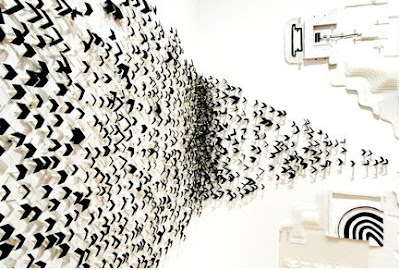
(image: Swarm, 2003-2007)

You use materials like pom poms, pipe cleaners, post its, foam core--How did you start using these particular materials?

Each of the materials you mention has its own little history and in some cases the histories overlap. In general, I am attracted to everyday objects such as post-its and sharpie markers that exist outside the context of fine art. Since so much of the work I do initially grew out of my doodling, it initially seemed natural to use materials that like the doodle had humble origins. Sharpies, post-its, pushpins, staples, scotch tape all fell within this category. Also, starting with something that isn’t particularly special offers more potential for metamorphosis. I am rarely attracted to commercially produced objects that are too specific and identifiable. Pom poms and colored pipe cleaners, on the other hand, attracted me partly because I didn’t know what the hell they were for, and that reminds me of my attraction to the interior of security envelopes. In security envelopes there is so much attention to color and detail, and for what? For me, there is poignancy in this. There are all these intricate patterns and colors inside a security envelope that you don’t even see until you tear it open it and then once you’ve opened it you throw it out and forget about it. The aesthetic impulse and its relationship to futility fascinate me.

But to return to your question, most of the materials I use possess two qualities: familiarity and malleability. The pom poms, however, do differ from the rest. I first encountered them when teaching art to elementary school students. I taught in an outreach program for seven years in Spanish Harlem. These saccharine colored fluffy balls initially repelled me. But I eventually incorporated them into my own art. I think I am attracted to things that don’t quite belong. Part of the interest for me lies in the act of mediation. The pom pom, like the felt I use, has the added benefit of being tactile, of mixing up the sensory experiences of seeing and touching.
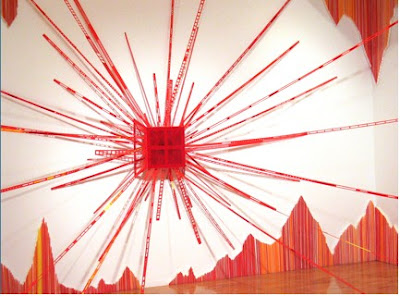
(image: Orange Alert, 2008)

Since your work is non-traditional, is there a location outside of the gallery setting where you would like to see it exhibited?
My first response to your question is what does the term ‘non-traditional art’ mean these days? I guess I feel like so much of contemporary art could be described this way. That said, I have just completed my first permanent public artwork, so I have just experienced exhibiting outside the gallery, and it was extremely gratifying. I made a 107ft long piece at a new public school in Staten Island using wood, MDF, Nida-Core, acrylic paint and glass. It was commissioned by New York City’s Percent for Art Program and the NYC Construction Authority’s Public Art in Public School’s Program. Making an artwork in a place where people rarely encounter contemporary art was very meaningful to me. It made me think of the time I taught in Harlem. Looking back, I realize that was the most meaningful day job I have ever had. I installed my piece in two stages and was working on it while the building was being finished and the school year was about to begin. So I interacted with construction workers, bureaucrats, security guards, custodians, teachers, students and parents. It was great to hear their reactions and questions. In the future, I would love an opportunity to make a work inside a hospital or outside on a busy street.

(image: Out of the Corner of My Eye, 2008-2009)

What inspires you?

So much! Let’s see, other artists’ work of course, a good conversation, architecture, construction sites, films, nature (especially trees), and industrial design and engineering, what I see on the tarmac at an airport or in a hospital. Perhaps music is number one, I honestly don’t feel like I could get through the day if I did not have music. But to be more specific, recent sources of inspiration have been Gaudi, the IBM History Flow Charts of Wikipedia, Stephen Holl’s MIT Dormitory, Ohad Naharin’s dance “Max,” Sol Lewitts’ letter to Eva Hesse (1965) the recent documentary on Louise Bourgeois, “Man on a Wire,” and Julian Schnabel’s “The Diving Bell and the Butterfly.”

What project(s) are you currently working on?
Since I just completed “Out of the Corner of My Eye,” the Percent for Art Installation in Staten Island, I am a bit in transition and trying to change gears so that I can get started in the studio again. It has been at least two years since I have had a normal studio practice that was not overshadowed by an impending deadline. I am looking forward to being aimless and alone in my studio for a while!

How do you get through artist's block?
I listen to music and start singing along very loudly!

What is a typical week in your life like?
I don’t feel like I have typical weeks at the moment but I am working on creating more structure in my life. I have always found living in NYC extremely distracting and inspiring at the same time!

Are there any words that you live by? or a particular philosophy that you believe in when it comes to life and art and pursuing a creative form of expression?
This might sound somewhat contradictory but I try to be both open minded and true to myself. I also try not to take the easy way out.

Diana Cooper lives and works in New York. To see more of her constructions, visit her website!

27 March 2009

Spotlight on Steve Schick


Last summer, Douglas and I saw Steve Schick in concert with the Pittsburgh New Music Ensemble. Steve's concert was amazing and inspiring-- So, I emailed him and asked if he would be willing to answer some questions- and he graciously agreed!

You have quite an array of percussion instruments that you laid out for your concert here in Pittsburgh, how large is your collection? What are the most unusual instruments in your collection and where did they come from?
I do have lots of instruments in my studio -- maybe there are 500 hundred of them if you include all of the little things . On the other hand I am not really an instrument collector. So many percussionists travel and bring back exotic instruments. My assortment is really very noisy, and 'impoverished.' I want people to listen to the music not the sounds.

It's very apparent that you have really honed your musicianship skills -working with various instruments, learning how to play various complex pieces, creating muscle memory, how much time do you devote to your practice and how do you practice?
I practice, under good circumstances, around 3-4 hours a day. I really prefer to practice in the morning.

I was totally amazed with the solo triangle piece-- can you talk about your experience performing it? learning to play it? the idea of making the triangle vibrate and thereby hearing the sound of the room reverberate-- it's a really beautiful and kind of zen concept!....
I wish I had something wise to say about the triangle piece. I agree, it's fascinating.You learn to play this piece simply by listening to the triangle and then going after the interesting sounds as they emerge one after the other.

What projects are you currently working on?
I am in New York now, conductng the ICE ensemble in rehearsals for an all-Xenakis concert we will present in Boston, Chicago and New York. I just finished an evening-length solo theatrical piece by Paul Dresher and Rinde Eckert called "Schick Machine." In the next month I am premiering a piece by Roger Reynolds, Rand Steiger and conducting Mahler #2. It is an interesting time.

What musicians, teachers, mentors, books, (or other) have had the greatest impact on your career as a solo percussionist?
I had two great teachers Bernhard Wulff and Thomas L. Davis. My friend the pianist James Avery recently died as did Betty Freeman, another great friend. I think of them now as I answer your question.

What inspires you?
Walking with my wife. I mean both my wife and walking.

Can you talk about your sense of hearing..I think that you probably hear the world in a different way than the average person, do you hear silence? are you sensitive to sound when you are out and about- getting your morning coffee or walking in the park?
Two years ago I walked 700 miles from San Diego to San Francisco to listen to the sounds of the California coast. I started by wanting to observe the differences between music and the sounds of the outside world, and ended by seeing (hearing) the commonalities. It was a fabulous 5 1/2 week adventure!

You have carved out an interesting niche for yourself as a musician-- did you ever have a difficult time or obstacles in your career that you had to overcome?
I have alternated between periods of great specialization -- almost always on percussion -- and periods when I did many things. The latter includes writing, conducting, improvising, walking. I am in a diverse phase now, which sometimes leads to people not being able to categorize me. Mostly that's a good thing but then sometimes you want an uncluttered life.

What words or philosophy do you live by?
I love the Kurt Vonnegut quotation:

"We were put here on this earth to fart around. Don't let anyone tell you any different."

Steven Schick
was born in Iowa and raised in a farming family. For the past thirty years he has championed contemporary percussion music as a performer and teacher, by commissioning and premiering more than one hundred new works for percussion. Schick is Distinguished Professor of Music at the University of California, San Diego and a Consulting Artist in Percussion at the Manhattan School of Music. He was the percussionist of the Bang on a Can All-Stars of New York City from 1992-2002, and from 2000 to 2004 served as Artistic Director of the Centre International de Percussion de Genève in Geneva, Switzerland. Schick is founder and Artistic Director of the percussion group, "red fish blue fish," and in 2007 assumed the post of Music Director and conductor of the La Jolla Symphony and Chorus.
Steven Schick recently released three important publications. His book on solo percussion music, "The Percussionist's Art: Same Bed, Different Dreams," was published by the University of Rochester Press; his recording of "The Mathematics of Resonant Bodies" by John Luther Adams was released by Cantaloupe Music; and, a 3 CD set of the complete percussion music of Iannis Xenakis, made in collaboration with red fish blue fish, was issued by Mode Records. For more info about Steve, click here.


Thanks Steve!!!!