(Personnage, 1971)21 April 2009
18 April 2009
Fallingwater, moss gardens, Japanese Soaking Tubs
I went on a little family excursion to Fallingwater last week. It is an extraordinary place-- where the boundaries between indoors and out are blurred. Ever since our visit, I have been thinking about Japanese soaking tubs and moss gardens. Probably because we walked outside the back of the house and there was a garden at hip level made from the exterior of the wall. It was very damp and drippy- planted with moss and rocks. (These images are not from Fallingwater).
The original inhabitants of the house were the Kaufmann's-- owners of the department store. They were ahead of their time in terms of conservation and sustainability in the 40's.
In the bookstore, there was a wonderful collection of books about organic gardening and Japanese design, including a book about Japanese soaking tubs with beautiful photographs of these tiny pod shaped tubs that just cradle a person like an egg.

From the book: The Japanese Bath By Bruce Smith, Yoshiko Yamamoto
"In the West, a bath is a place one goes to cleanse the body. In Japan, one goes there to cleanse the soul. Bathing in Japan is about much more than cleanliness: it is about family and community. It is about being alone and contemplative, time to watch the moon rise above the garden. Along with sixty full-color illustrations of the light and airy baths themselves, The Japanese Bath, delves into the aesthetic of bathing Japanese style and the innate beauty of the steps surrounding the process. The authors explain how to create a Japanese bath in your own home. A Zen meditation, the Japanese bath, indeed, cleanses the soul, and one emerges refreshed, renewed, and serene."
06 April 2009
Spotlight on....Diana Cooper

(Diana Cooper in front of Out of the Corner of My Eye, Staten Island, NY)
Do you have a daily ritual that prepares you to go to work in your studio?
No, I am not very good about incorporating rituals into my daily life. In fact, I always find it difficult to leave a place, whether it be my home or my studio. Wherever I am seems to be the place I want to be. But to facilitate the transition from the home to the studio, I will often start my day by making a list of what I plan to do that day. I fortunately have a strong work ethic that usually overrides the more disorganized and distracted side of my personality.
(The Dispenser, 1999)Can you talk about your art practice? What kind of source material do you collect? How does a piece develop?
I feel like there is little separation between my life and my art, which of course brings with it a host of problems, but it also means that when I am not in the studio I am not intellectually, visually or emotionally far away from my work. Aside from the act of making, looking is probably the most stimulating thing I can do. Also photographing things. Photography has become a sketchbook of sorts. Especially when I am traveling alone.
I buy art books, postcards of artworks, stuff that catches my eye and might inspire me or be used in an artwork. I am also frequently cutting photographs out the New York Times, and printing images from the Internet and pinning them to my studio walls.
(images pinned to the wall in Diana's studio)
It is difficult for me to generalize on how a piece develops because there are many different ways in which I work. But perhaps most importantly is the fact that most of my pieces are linked together in some way, they feed each other. So even though I rarely start with a sketch or a preparatory drawing, I feel as though I am not starting from scratch. In a way, my work is simultaneously the sketch and the finished product. The process of making is almost always revealed to some extent in the finished work. A piece can start with a shape, a color or a simple set of rules or from an image or an idea that was only partially developed in a previous work or has been bopping around in my head for a while.
Your work is so colorful, energetic and playful--it seems to me to be the work of someone who loves to experiment and is truly in the creative flow, did you ever have doubts about what you were doing or doubts about becoming an artist?
I often have doubts. I wish this were not the case! But that is not to say that I don’t love what I do. For me, art making is a transportive experience. I feel very lucky to have something that gives me so much and that hopefully gives to others as well. The making of each piece has its own story but almost without fail there is a point in the process when I feel like I will never figure things out and never be able to finish it.
I had a lot of doubts about becoming an artist. It was a very complicated decision on so many levels. Both my parents were artists and teachers. I was exposed to both the joys and hardships of growing up in that environment. I grew up with two conflicting impulses: to embrace a creative life and to flee it; art was what gave life meaning but was also what made life so difficult.
Something I rarely talk about is the fact that my first love was dance and I danced, improvised and choreographed from a very early age. It was the improvisational and expressive nature of choreography and its relationship to music that attracted me to it.
You are using a variety of very interesting techniques-- building onto the surface of the picture plane, paper cut-outs, drawing and repetition, 3-d elements that cascade down the wall onto the floor. Do these techniques occur naturally through experimentation or have they always been inherent in the way that you work?
No, these techniques have not always been inherent in the way I work. I was first a painter. But I was a painter who always loved drawing and especially collage. I do remember wondering why everyone so slavishly adhered to the square and rectangle when making drawings or paintings and why it was assumed that paper equals drawing and canvas equals painting. These rules seemed arbitrary and unnecessarily confining to me.
The impulses to experiment and to improvise are at the heart of what I do. But as I get older, I have begun to realize that the 3-d nature of the work, and in particular, the spatial and experiential aspects, really hark back to the years when I danced. It wasn’t until 2005 that I became aware of the connection. In fact, it was a dancer/choreographer who brought it to my attention. For instance, for me the thousands of black paper arrows in “Swarm” evoke sound and movement, and in “Orange Alert UK,” the central spider/starburst form is the visual equivalent of a piercing alarm. There is a synaesthetic component to these works. In a way, I feel like I am trying to make visual art do things it is not fully capable of doing: to evoke sensory reactions not generally associated with it.
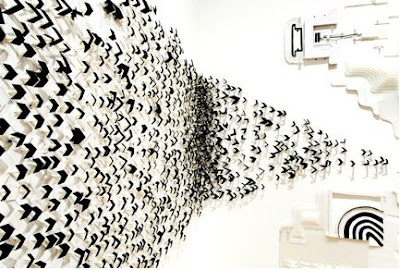
(image: Swarm, 2003-2007)You use materials like pom poms, pipe cleaners, post its, foam core--How did you start using these particular materials?
Each of the materials you mention has its own little history and in some cases the histories overlap. In general, I am attracted to everyday objects such as post-its and sharpie markers that exist outside the context of fine art. Since so much of the work I do initially grew out of my doodling, it initially seemed natural to use materials that like the doodle had humble origins. Sharpies, post-its, pushpins, staples, scotch tape all fell within this category. Also, starting with something that isn’t particularly special offers more potential for metamorphosis. I am rarely attracted to commercially produced objects that are too specific and identifiable. Pom poms and colored pipe cleaners, on the other hand, attracted me partly because I didn’t know what the hell they were for, and that reminds me of my attraction to the interior of security envelopes. In security envelopes there is so much attention to color and detail, and for what? For me, there is poignancy in this. There are all these intricate patterns and colors inside a security envelope that you don’t even see until you tear it open it and then once you’ve opened it you throw it out and forget about it. The aesthetic impulse and its relationship to futility fascinate me.
But to return to your question, most of the materials I use possess two qualities: familiarity and malleability. The pom poms, however, do differ from the rest. I first encountered them when teaching art to elementary school students. I taught in an outreach program for seven years in Spanish Harlem. These saccharine colored fluffy balls initially repelled me. But I eventually incorporated them into my own art. I think I am attracted to things that don’t quite belong. Part of the interest for me lies in the act of mediation. The pom pom, like the felt I use, has the added benefit of being tactile, of mixing up the sensory experiences of seeing and touching.
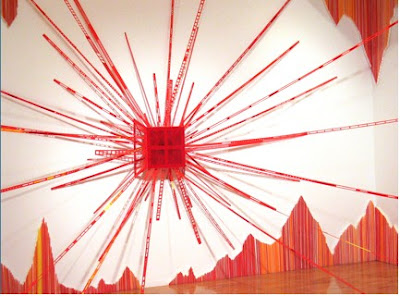
(image: Orange Alert, 2008)Since your work is non-traditional, is there a location outside of the gallery setting where you would like to see it exhibited?
My first response to your question is what does the term ‘non-traditional art’ mean these days? I guess I feel like so much of contemporary art could be described this way. That said, I have just completed my first permanent public artwork, so I have just experienced exhibiting outside the gallery, and it was extremely gratifying. I made a 107ft long piece at a new public school in Staten Island using wood, MDF, Nida-Core, acrylic paint and glass. It was commissioned by New York City’s Percent for Art Program and the NYC Construction Authority’s Public Art in Public School’s Program. Making an artwork in a place where people rarely encounter contemporary art was very meaningful to me. It made me think of the time I taught in Harlem. Looking back, I realize that was the most meaningful day job I have ever had. I installed my piece in two stages and was working on it while the building was being finished and the school year was about to begin. So I interacted with construction workers, bureaucrats, security guards, custodians, teachers, students and parents. It was great to hear their reactions and questions. In the future, I would love an opportunity to make a work inside a hospital or outside on a busy street.
(image: Out of the Corner of My Eye, 2008-2009)What inspires you?
So much! Let’s see, other artists’ work of course, a good conversation, architecture, construction sites, films, nature (especially trees), and industrial design and engineering, what I see on the tarmac at an airport or in a hospital. Perhaps music is number one, I honestly don’t feel like I could get through the day if I did not have music. But to be more specific, recent sources of inspiration have been Gaudi, the IBM History Flow Charts of Wikipedia, Stephen Holl’s MIT Dormitory, Ohad Naharin’s dance “Max,” Sol Lewitts’ letter to Eva Hesse (1965) the recent documentary on Louise Bourgeois, “Man on a Wire,” and Julian Schnabel’s “The Diving Bell and the Butterfly.”
What project(s) are you currently working on?
Since I just completed “Out of the Corner of My Eye,” the Percent for Art Installation in Staten Island, I am a bit in transition and trying to change gears so that I can get started in the studio again. It has been at least two years since I have had a normal studio practice that was not overshadowed by an impending deadline. I am looking forward to being aimless and alone in my studio for a while!
How do you get through artist's block?
I listen to music and start singing along very loudly!
What is a typical week in your life like?
I don’t feel like I have typical weeks at the moment but I am working on creating more structure in my life. I have always found living in NYC extremely distracting and inspiring at the same time!
Are there any words that you live by? or a particular philosophy that you believe in when it comes to life and art and pursuing a creative form of expression?
This might sound somewhat contradictory but I try to be both open minded and true to myself. I also try not to take the easy way out.
Diana Cooper lives and works in New York. To see more of her constructions, visit her website!
27 March 2009
Spotlight on Steve Schick

Last summer, Douglas and I saw Steve Schick in concert with the Pittsburgh New Music Ensemble. Steve's concert was amazing and inspiring-- So, I emailed him and asked if he would be willing to answer some questions- and he graciously agreed!
You have quite an array of percussion instruments that you laid out for your concert here in Pittsburgh, how large is your collection? What are the most unusual instruments in your collection and where did they come from?
I do have lots of instruments in my studio -- maybe there are 500 hundred of them if you include all of the little things . On the other hand I am not really an instrument collector. So many percussionists travel and bring back exotic instruments. My assortment is really very noisy, and 'impoverished.' I want people to listen to the music not the sounds.
It's very apparent that you have really honed your musicianship skills -working with various instruments, learning how to play various complex pieces, creating muscle memory, how much time do you devote to your practice and how do you practice?
I practice, under good circumstances, around 3-4 hours a day. I really prefer to practice in the morning.
I was totally amazed with the solo triangle piece-- can you talk about your experience performing it? learning to play it? the idea of making the triangle vibrate and thereby hearing the sound of the room reverberate-- it's a really beautiful and kind of zen concept!....
I wish I had something wise to say about the triangle piece. I agree, it's fascinating.You learn to play this piece simply by listening to the triangle and then going after the interesting sounds as they emerge one after the other.
What projects are you currently working on?
I am in New York now, conductng the ICE ensemble in rehearsals for an all-Xenakis concert we will present in Boston, Chicago and New York. I just finished an evening-length solo theatrical piece by Paul Dresher and Rinde Eckert called "Schick Machine." In the next month I am premiering a piece by Roger Reynolds, Rand Steiger and conducting Mahler #2. It is an interesting time.
What musicians, teachers, mentors, books, (or other) have had the greatest impact on your career as a solo percussionist?
I had two great teachers Bernhard Wulff and Thomas L. Davis. My friend the pianist James Avery recently died as did Betty Freeman, another great friend. I think of them now as I answer your question.
What inspires you?
Walking with my wife. I mean both my wife and walking.
Can you talk about your sense of hearing..I think that you probably hear the world in a different way than the average person, do you hear silence? are you sensitive to sound when you are out and about- getting your morning coffee or walking in the park?
Two years ago I walked 700 miles from San Diego to San Francisco to listen to the sounds of the California coast. I started by wanting to observe the differences between music and the sounds of the outside world, and ended by seeing (hearing) the commonalities. It was a fabulous 5 1/2 week adventure!
You have carved out an interesting niche for yourself as a musician-- did you ever have a difficult time or obstacles in your career that you had to overcome?
I have alternated between periods of great specialization -- almost always on percussion -- and periods when I did many things. The latter includes writing, conducting, improvising, walking. I am in a diverse phase now, which sometimes leads to people not being able to categorize me. Mostly that's a good thing but then sometimes you want an uncluttered life.
What words or philosophy do you live by?
I love the Kurt Vonnegut quotation:
I do have lots of instruments in my studio -- maybe there are 500 hundred of them if you include all of the little things . On the other hand I am not really an instrument collector. So many percussionists travel and bring back exotic instruments. My assortment is really very noisy, and 'impoverished.' I want people to listen to the music not the sounds.
It's very apparent that you have really honed your musicianship skills -working with various instruments, learning how to play various complex pieces, creating muscle memory, how much time do you devote to your practice and how do you practice?
I practice, under good circumstances, around 3-4 hours a day. I really prefer to practice in the morning.
I was totally amazed with the solo triangle piece-- can you talk about your experience performing it? learning to play it? the idea of making the triangle vibrate and thereby hearing the sound of the room reverberate-- it's a really beautiful and kind of zen concept!....
I wish I had something wise to say about the triangle piece. I agree, it's fascinating.You learn to play this piece simply by listening to the triangle and then going after the interesting sounds as they emerge one after the other.
What projects are you currently working on?
I am in New York now, conductng the ICE ensemble in rehearsals for an all-Xenakis concert we will present in Boston, Chicago and New York. I just finished an evening-length solo theatrical piece by Paul Dresher and Rinde Eckert called "Schick Machine." In the next month I am premiering a piece by Roger Reynolds, Rand Steiger and conducting Mahler #2. It is an interesting time.
What musicians, teachers, mentors, books, (or other) have had the greatest impact on your career as a solo percussionist?
I had two great teachers Bernhard Wulff and Thomas L. Davis. My friend the pianist James Avery recently died as did Betty Freeman, another great friend. I think of them now as I answer your question.
What inspires you?
Walking with my wife. I mean both my wife and walking.
Can you talk about your sense of hearing..I think that you probably hear the world in a different way than the average person, do you hear silence? are you sensitive to sound when you are out and about- getting your morning coffee or walking in the park?
Two years ago I walked 700 miles from San Diego to San Francisco to listen to the sounds of the California coast. I started by wanting to observe the differences between music and the sounds of the outside world, and ended by seeing (hearing) the commonalities. It was a fabulous 5 1/2 week adventure!
You have carved out an interesting niche for yourself as a musician-- did you ever have a difficult time or obstacles in your career that you had to overcome?
I have alternated between periods of great specialization -- almost always on percussion -- and periods when I did many things. The latter includes writing, conducting, improvising, walking. I am in a diverse phase now, which sometimes leads to people not being able to categorize me. Mostly that's a good thing but then sometimes you want an uncluttered life.
What words or philosophy do you live by?
I love the Kurt Vonnegut quotation:
"We were put here on this earth to fart around. Don't let anyone tell you any different."
Steven Schick was born in Iowa and raised in a farming family. For the past thirty years he has championed contemporary percussion music as a performer and teacher, by commissioning and premiering more than one hundred new works for percussion. Schick is Distinguished Professor of Music at the University of California, San Diego and a Consulting Artist in Percussion at the Manhattan School of Music. He was the percussionist of the Bang on a Can All-Stars of New York City from 1992-2002, and from 2000 to 2004 served as Artistic Director of the Centre International de Percussion de Genève in Geneva, Switzerland. Schick is founder and Artistic Director of the percussion group, "red fish blue fish," and in 2007 assumed the post of Music Director and conductor of the La Jolla Symphony and Chorus.
Steven Schick recently released three important publications. His book on solo percussion music, "The Percussionist's Art: Same Bed, Different Dreams," was published by the University of Rochester Press; his recording of "The Mathematics of Resonant Bodies" by John Luther Adams was released by Cantaloupe Music; and, a 3 CD set of the complete percussion music of Iannis Xenakis, made in collaboration with red fish blue fish, was issued by Mode Records. For more info about Steve, click here.
Thanks Steve!!!!
20 March 2009
Spotlight on....Julia Pogodina

How did your career in fashion photography unfold?
On July 15th, 2006 I quit my job as a foreign associate at Sidley Austin law firm in NY and started doing photography full-time.
But I guess it all started much earlier. As a child, I stayed up all night with my Dad in our homemade darkroom watching him develop b&w pictures from our family trips to the Black sea. Then it was my first camera, a 35mm Lomo compact that I received for my 8th birthday. And lots of art books in my parents library, weekly trips to the museums and exhibitions with my parents, beautiful art pieces & pictures on the wall of our apartment in St.Peterbsurg where I grew up. My parents always encouraged my artistic beginnings (my Dad himself is an antique restorer & jeweler) but the harsh reality of post-Soviet Russia didn’t allow the luxury to pursue your inclinations when it was time to choose where to go to school. Instead, stable income and prestige were the criteria in choosing your future career. The latter together with my excellent grades in school brought me to St. Peteresburg Law school at the age of 18. It took me 9 years to realize that it was a mistake. Without regretting the past I moved on to a very uncertain future and started a new career, fresh, without proper education, at the age of 27.
Honestly, there was no smooth transition between being a corporate lawyer and becoming a fashion photographer. I guess there couldn’t be. It was abrupt, unexpected, scary, and very exciting. I’m not sure I’d be able to do it again if I had to... It takes not only guts but also some kind of blind fearlessness, courage and sense of adventure. It’s like jumping with the parachute for the first time. I loved it! But I would be very cautious to recommend anyone to repeat this path.
2.5 years later everything is different now starting with my self. The way I look, the way I spend my day, my circle of friends and acquaintances, the place where I live. Elegant suits and high heels were replaced by jeans and converse sneakers. My tiny studio in a fancy building in the West Village was abandoned for a spacious loft in East Williamsburg. But the biggest changes happened in my head. Living your dream is a difficult thing. Dreaming about being an artist is easier then becoming one. It is not an overnight process and I still have a long and exciting journey ahead.

Can you talk about collaborating with stylists, makeup artists, models, etc. Each designer has a task but you are all working together to create a look, how does this collaboration work?
In fashion photography – opposite to fine art photography, for example, - team is a key. A glossy picture that you see in a magazine is always a collaborative effort – of an art director, photographer, model, stylist, set designer, make-up artists, hair stylist, photo retoucher, layout designer, etc, etc. It’s a huge production, and each level of it is crucial.
I personally always liked that part. I love working with creative people and this is one of the reasons I’m in this industry. It’s different from the type of team work people talk about in the offices – here it’s not as technical. It is a mix of creativity & different personalities. Magical in a way, and very powerful. Sometimes you feel that you have no control over it; this is when beautiful things are happening – when each team member is in love with the project and you see everybody’s unique touch in the final outcome.
There are no rules in this process, I believe. With my team I’m usually the one throwing initial ideas on the table. Some inspiration, a couple of reference pictures, a short description of a concept. Then each member of the team starts working on his own part. Here I usually give complete freedom and always encourage them to experiment and create something unique. Sometimes it works, sometimes it doesn’t, but at the end it’s all a learning curve, where an ultimate goal is to find and express yourself.

What does the medium of photography mean to you - and why did you choose it?
I like photography for its immediate and true results. I’m not fascinated by the process of depicting a subject (for example in painting) but instead by the subject itself. In my case, it’s beautiful people - and the moment they live in. In a way it’s all about pre-production – my team and I are spending days prepping for the shoot and hours creating a look for the camera. This look usually lives for just a couple of minutes. The camera gives me a chance to capture it imminently, intimately, as I see it - and deliver the message to the viewer later on. I think only video can compete with that, but that’s a different story.
What inspires you?
Lots of things. The people around me. The places I used to live or visit. My childhood memories. Literature. Movies. Exhibitions. Music. Sometimes inspiration is very directional, for example, I can watch the Pillow book by Peter Greenaway and my head starts spinning with ideas about a fashion shoot inspired by the style of the film. But usually it’s more complex. Ideas come as a mix of experiences and aftertastes, dreams and fears, sounds and quotes, flashbacks of emotions.
What photographers, artists, books, fashion designers, or mentors, etc. have influenced you creatively?
If I ever need to write down all the acknowledgements that will constitute a whole book which will be interesting only for those mentioned in it. And this list continues growing every day.
I am blessed to be surrounded by incredibly talented, wise, creative, big-hearted people who always inspire and encourage me. At first it was my Dad who taught me to draw way before I could read and write; my childhood was filled with color pencils, watercolor sets, and canvas paper. My Mom was the one who cultivated a taste in fashion in me; she was the one sewing all my clothes since I was little, and always making me “the-best-dressed” girl in high school. Then it was FTV channel – one of the first foreign channels in post-Soviet Russia along with MTV. I was 16 and I was addicted. I could watch show after show all day long (skipping classes in school, of course). I knew all of the designers and their collections by heart year after year. The first fashion photographer I met was Andrey Borichevskii, my good old friend from St.Petersburg. He was the one who introduced me to names like Mario Testino and Nick Knight. He also showed me Italian Vogue for the first time. There were many others later on: photographers, artists and friends, each of whom added his or her little touch & inspiration to forming this passion in me .
As of now I’m breathing editorials and ad work by Steven Meisel & Steven Klein, Craig McDean, Marcus & Piggot. They are my virtual mentors when it comes to style and quality in fashion photography.
Lots of things. The people around me. The places I used to live or visit. My childhood memories. Literature. Movies. Exhibitions. Music. Sometimes inspiration is very directional, for example, I can watch the Pillow book by Peter Greenaway and my head starts spinning with ideas about a fashion shoot inspired by the style of the film. But usually it’s more complex. Ideas come as a mix of experiences and aftertastes, dreams and fears, sounds and quotes, flashbacks of emotions.
What photographers, artists, books, fashion designers, or mentors, etc. have influenced you creatively?
If I ever need to write down all the acknowledgements that will constitute a whole book which will be interesting only for those mentioned in it. And this list continues growing every day.
I am blessed to be surrounded by incredibly talented, wise, creative, big-hearted people who always inspire and encourage me. At first it was my Dad who taught me to draw way before I could read and write; my childhood was filled with color pencils, watercolor sets, and canvas paper. My Mom was the one who cultivated a taste in fashion in me; she was the one sewing all my clothes since I was little, and always making me “the-best-dressed” girl in high school. Then it was FTV channel – one of the first foreign channels in post-Soviet Russia along with MTV. I was 16 and I was addicted. I could watch show after show all day long (skipping classes in school, of course). I knew all of the designers and their collections by heart year after year. The first fashion photographer I met was Andrey Borichevskii, my good old friend from St.Petersburg. He was the one who introduced me to names like Mario Testino and Nick Knight. He also showed me Italian Vogue for the first time. There were many others later on: photographers, artists and friends, each of whom added his or her little touch & inspiration to forming this passion in me .
As of now I’m breathing editorials and ad work by Steven Meisel & Steven Klein, Craig McDean, Marcus & Piggot. They are my virtual mentors when it comes to style and quality in fashion photography.

What does the medium of photography mean to you - and why did you choose it?
I like photography for its immediate and true results. I’m not fascinated by the process of depicting a subject (for example in painting) but instead by the subject itself. In my case, it’s beautiful people - and the moment they live in. In a way it’s all about pre-production – my team and I are spending days prepping for the shoot and hours creating a look for the camera. This look usually lives for just a couple of minutes. The camera gives me a chance to capture it imminently, intimately, as I see it - and deliver the message to the viewer later on. I think only video can compete with that, but that’s a different story.
What is the most difficult part of what you do? What do you like best about what you do or create?
The most difficult part is the people. This is also the part I like the most. This is the only part of the job that is always unpredictable, always out of control. It makes it challenging and magical.
What do you like to do when you're not shooting photographs?
Sleep. Read. Watch movies. Travel. Cook. In random order.
What is your dream project?
My dream project is to shoot the Pirelli calendar. Or to travel on assignment from Vogue to an exotic location – like Africa or Iceland – with my team.
What words or philosophy do you live by?
The sky is the limit!
Julia Pogodina moved from Moscow to New York in 2005 to pursue her dream. After 7 years of being a corporate lawyer she quit her office job and became a freelance fashion/beauty photographer. Her pictures stand out for their saturated colors, dynamic compositions, profound lighting and dreamy locations. Julia's commercial and editorial work, along with a list of publications can be seen at http://www.nymfea.com/.
Thanks Julia!
The most difficult part is the people. This is also the part I like the most. This is the only part of the job that is always unpredictable, always out of control. It makes it challenging and magical.
What do you like to do when you're not shooting photographs?
Sleep. Read. Watch movies. Travel. Cook. In random order.
What is your dream project?
My dream project is to shoot the Pirelli calendar. Or to travel on assignment from Vogue to an exotic location – like Africa or Iceland – with my team.
What words or philosophy do you live by?
The sky is the limit!
Julia Pogodina moved from Moscow to New York in 2005 to pursue her dream. After 7 years of being a corporate lawyer she quit her office job and became a freelance fashion/beauty photographer. Her pictures stand out for their saturated colors, dynamic compositions, profound lighting and dreamy locations. Julia's commercial and editorial work, along with a list of publications can be seen at http://www.nymfea.com/.Thanks Julia!
18 March 2009
BUS 4 Urban Scrawl at Bricolage
Tami Dixon invited me to donate a piece of artwork to the Bricolage BUS 4 annual fundraiser. It's a crazy one night only event-- not to be missed!
This piece will be available for auction at the event on March 21st.

Lauren Braun
Bricolage Collage
2009
9in. x 12in. x 1.5in.
Cardboard, tissue paper, prayer paper, packaging, white paint collage mounted on wood panel
This piece will be available for auction at the event on March 21st.

Lauren Braun
Bricolage Collage
2009
9in. x 12in. x 1.5in.
Cardboard, tissue paper, prayer paper, packaging, white paint collage mounted on wood panel
17 March 2009
Buffalo, City of my Heart
(view from across the park/pond behind the Albright Knox Art Gallery)Buffalo. Say the name and people conjure up images of the Bills, chicken wings, and tons and tons of snow. But there is so much more to this city than sports, fried food, and lake effect snowstorms.
(If you told me I would be saying that back in 1992- I would have called you crazy!)
I'm here to tell you that Buffalo is an awesome, culturally diverse city filled with great people, a unique arts community, notable architecture, lots of small businesses that add flavor and creativity to the urban fabric, lovely parks and TONS of potential for the future! There are so many cool things about Buffalo-- I wish I could list them all right here but that would take a really long time. Instead I'm just going to list some links that compile all the information already.
Buffalo Rising
Buffalo Niagara Visitors Bureau
Forever Elmwood
Artvoice
Gardenwalk
Buffalo Rising
Buffalo Niagara Visitors Bureau
Forever Elmwood
Artvoice
Gardenwalk
After visiting home this past weekend I had a vivid (day)dream.....Although I have made my home in Pittsburgh, I envisioned that in some alternate universe in the future, I will some day move back to Buffalo, buy an old house downtown to fix up, plant a garden in the backyard and open up a hip little gallery with artist studios.
ps. the new cafe on the corner of Grant and Lafayette, Sweet_ness 7, is a really cool, laid back spot to drink coffee and read or chat with friends! They used a lot of re-purposed materials to decorate and it's just a beautiful space that has obviously had a lot of love and thought put into it!
Here we are: Molly, me, and Amy-- NJP is behind the lens at Sweet_ness 7!12 March 2009
Spotlight on....Margaux Lange
A few weeks ago, I read an article in the NY Times Magazine called Deconstructing Barbie by Rob Walker, about an art jeweler named Margaux Lange who uses Barbie dolls to make jewelry. My interest was piqued so I looked at her website and blog- and was enamored with her work and inspired by the fact that she recently quit her day job to pursue her art full- time.(Photo: Margaux amongst her muses.)
Can you talk about how your career is unfolding?
This is a tough one to sum up in a few paragraphs so I'll try to just hit the major biographical bullet points:
• worked at a production jewelry company after college - didn't love it, but it helped me to realize that working as a pair of hands for someone else was definitely NOT what I wanted to do with my career.
• approached two major art jewelry galleries with my "Plastic Body Series" and was immediately taken on: Julie Artisans' Gallery in NYC and FacĂ©rĂ© Jewelry Art Gallery in Seattle.
• steadily applied to more juried shows and took on other gallery representation for my one-offs in various other galleries across the US.
• debated grad school but decided to move to NYC instead.
• decided I needed to diversify my price points, so I opened an etsy shop to sell my production pieces, which are more paired-down works in the series that I make in multiples at a lower price than my one-offs.
• worked temporarily for several jewelers in NYC doing contract labor before ending up working for a woman who had a wholesale jewelry business and ran a gift boutique in Brooklyn. Working in retail and learning about running a wholesale jewelry business taught me a lot!
• created a wholesale catalog for my work, and took on my first few wholesale accounts.

• found my dream studio 5 blocks away from my apartment.
• quit my part-time job to pursue my jewelry full time!
Do you have a ritual that gets you ready and rarin' to go to the studio?
I wake up, make myself some iced coffee (summer or winter - always iced) and sit down at my desk to deal with my computer related business tasks of the day: making lists, emails, blogging, bills, printing shipping labels, etc. After that, it's breakfast and a shower and I walk 5 blocks to my studio to start making work.
Can you describe your creative process, do you start with sketches? Do you play around with materials?
Most of my ideas will start with sketches, but other times I just begin arranging and playing with the Barbie doll parts or metal to see what interesting patterns/ shapes emerge.
What inspires you?
Humans-- human behavior and interactions, relationships, faces, expressions, bodies. Feminism, gender, pop culture. Patterns, colors, repetition, multiples, unusual or unexpected materials.
What is the most challenging part of your art or art making process?
Balancing the business side with the creative side and the time split between the two. And staying on top of my emails - a never ending battle for me!
What do you like to do when you're not making jewelry?
When I'm not making jewelry I really enjoy "nesting" ie: decorating and redecorating my apartment, looking at and buying other artist's work, etc. and spending time with my boyfriend and our crazy cats. When the weather's nice, outdoor activities also inspire me and keep my creativity on track. Exploring NYC and visiting my hometown of Lake George, NY are also at the top of my list.

I saw that you have a blog dedicated to some of the more notable reactions to your work, Creepy but Cool. Did you expect people to react to your work so strongly when you first started? How do you deal with this kind of feedback?
No, I didn't expect that people would react so strongly when I first started. Barbie is a loaded subject matter and that is an important aspect of my work. The range of responses I get to my work interests me. I love that everyone brings his or her own baggage. It is usually indicative of an individual's own relationship with, or feelings about the doll, as well as what may or may not define "wearable jewelry" to an individual. My goal has been to create art that a broad range of people can relate to and I feel I've been successful with this.
What is on your current reading list?
I read a lot about feminism as well as business related books. Currently on my nightstand:
Full Frontal Feminism by Jessica Valenti
The Artist's Way by Julia Cameron
The Beauty Myth by Naomi Wolf
Be Heard Now! by Lee Glickstein
The Artist-Gallery Partnership by Tad Crawford and Susan Mellon and the book that my boyfriend wants me to read because he insists I'll really like it: The Graveyard Book by Neil Gaiman.
I read a lot about feminism as well as business related books. Currently on my nightstand:
Full Frontal Feminism by Jessica Valenti
The Artist's Way by Julia Cameron
The Beauty Myth by Naomi Wolf
Be Heard Now! by Lee Glickstein
The Artist-Gallery Partnership by Tad Crawford and Susan Mellon and the book that my boyfriend wants me to read because he insists I'll really like it: The Graveyard Book by Neil Gaiman.
What does a typical week in your life look like?
There are no typical weeks. That's the thing about working for yourself, it's constantly fluctuating depending on what hat I have to wear that day, what deadlines are in front of me, or what needs to get done in my business and/or personal life. I love that my job also allows for a lot of flexibility in my schedule. Also, when you work for yourself your job doesn't really have set hours, so when I'm not in my studio making jewelry, I'm usually at home dealing with something
business related via the computer, etc. It's really more like a 24 hour job.
There are no typical weeks. That's the thing about working for yourself, it's constantly fluctuating depending on what hat I have to wear that day, what deadlines are in front of me, or what needs to get done in my business and/or personal life. I love that my job also allows for a lot of flexibility in my schedule. Also, when you work for yourself your job doesn't really have set hours, so when I'm not in my studio making jewelry, I'm usually at home dealing with something
business related via the computer, etc. It's really more like a 24 hour job.
What projects are you currently working on?
I just completed a large collection of work for a designer boutique in Paris called Colette. The shop has been transformed for the month of March in celebration of Barbie's 50th birthday. Various designers were selected to honor the icon with limited edition exclusive works for this special month long presentation. I'm also in the early planning stages for a solo show happening in December 2009 at Luke and Elloy Gallery in Pittsburgh PA.
Do you have a dream project?
I'm not sure I have a dream "project" per se, but I can happily declare that I am living my dream! Since August I've been a full-time artist. Ever since I was a little girl I've said, "I want to be an artist when I grow up" and now I am. Making art has always been what I enjoy above all else, so it was just a matter of finding a way to earn my living from it. I have the best job ever and I remind myself of that often.
What artists, mentors, jewelers, books, friends etc. have had an impact on your development as an artist and creative person?
• Kate Cusack: fellow artist and best friend. She has been my number one influence and support system for my art career ever since college.
Other people who stand out as having impacted my career:
• Mrs. Wilson: my high school art teacher and first ever jewelry/metals instructor
• Kate Cusack: fellow artist and best friend. She has been my number one influence and support system for my art career ever since college.
Other people who stand out as having impacted my career:
• Mrs. Wilson: my high school art teacher and first ever jewelry/metals instructor
• Kirsten Rook: my most inspiring college professor and jewelry instructor
• Todd Reed: art jeweler whom I admire. I met with him when I lived in CO and he reviewed my portfolio with great feedback (which at the time I presented to him in a shoe box, gasp!)
• Susan Kasson Sloan: took an epoxy resin workshop with her at Haystack in Maine, she's fantastic.
• My parents: who've always encouraged my creativity

• and of course my web & graphic designer (aka: my amazing, supportive boyfriend David Balogh)
As far as books: one of my all-time favorites is Art & Fear by David Bayles & Ted Orland.
What words do you live by?
"For a long time everybody refuses, and then almost without a pause, almost everyone accepts" - this is a quote that I cut out of a magazine when I was in high school and has been hung on the wall of every studio I've ever occupied. It has yellowed and is really beaten up now, but it still gives me comfort to see it there on my wall.
Also, "Do unto others as you would have them do unto you" (thanks Dad)

Margaux Lange lives and works in Brooklyn, NY. She re-Members Barbie™ fondly! Her Plastic Body Series Jewelry Collection is the result of her life-long fascination with the icon, and a desire to re-purpose mass produced materials into distinctly handmade, wearable artworks. Take a look at her website, her blog, and her etsy shop!!
Thanks Margaux!!
11 March 2009
A trip to the City of Brotherly Love
Douglas and I took a road trip to Philadelphia this past weekend to visit his family. We rolled into town Friday afternoon and went to the Museum of Art. They were celebrating Japan night with live music, cocktails and snacks. We wandered amongst the French Impressionists. We feasted our eyes on Van Gogh's Sunflowers, Degas's pastels paintings of ballerinas and various Picasso's.
(photo: This beautiful dress was decorated with moss and sedums.)We found a quiet cute little sushi restaurant. Instead of sitting at a table or the bar- we opted to sit in one of the booths where you take your shoes off and sit on the floor on a tatami mat. We had a delicious assortment of sushi, tempura spider roll, and instead of California roll- we asked for a chef's choice-- he made an eel roll wrapped in avocado slices with a sweet sauce, sprinkled with salmon roe and little greens that melted in my mouth! We shared a bottle of cold sake, and for dessert, tempura green tea ice cream -- SO delicious! We had the cutest waitress on the planet!

Saturday was devoted to the Italian themed flower show. We saw all kinds of crazy garden displays. Unfortunately, they weren't the kind that you could walk into on little paths (to keep people moving) as though they are little escapes into mini Utopian gardens. My favorite garden was a Tuscan vegetable and herb garden that had a distinct do-it-yourself feel....it was tucked behind tall cone shaped cypress bushes, nestled in between flowering shrubs and low growing plants.
(Photo: Another amazing dress constructed from various dried straw and stick materials)The highlight was the fashion/Milan section where designers created shoes, handbags and dresses out of all sorts of floral materials. There were some very beautiful accouterments.
Then came the individual plant prize winners, amazing for the sheer variety of plants, colors, textures, shapes and sizes. I have no idea what the criteria are for judging and how they chose 1st, 2nd or 3rd place but it's just really neat to see all the different types of plants and flowers that grow and how they take on funny persona's according to their looks.

Me, Douglas, Bruce and Martina having another impeccable meal- this time Thai. Too many delicious dishes to list and describe here-- it was all so delicious!!
10 March 2009
The Wonderful World of Kenneth Patchen
I forgot how I originally stumbled upon the poetry of Kenneth Patchen, I was in college at Syracuse University and I remember going to the rare books room on the 5th(?) floor of Bird Library to look at his manuscript in the collection. I was charmed by the illustrations, hand lettering and poetry. I ended up writing a paper about Patchen for some class and was on a mission to collect his books which were at that time, mostly out of print. When I was in Philly over the weekend, D. and I popped into a lovely independent bookstore, Joseph Fox Bookshop, - and lo and behold, sitting on the shelf was this newly printed Kenneth Patchen book with his illustrated poetry. I think his original drawings were in color- but this book is black and white. I wish it was slightly larger and that the poems were reproduced in color. But nonetheless, I'm happy I found it, and happier that D. bought it for me as a present! 26 February 2009
Spotlight on....Kate Cusack
Kate Cusack is a multi-talented artist living in Brooklyn, NY. Part sculptor, part designer, part jeweler--she creates elegant jewelry out of zippers, designs costumes for theater and window displays. Here, she talks a bit about her process, inspirations, and her current project.
You wear a couple of different artistic hats, as sculptor/jeweler/costume designer. How has your career unfolded?
(Photo: model wearing zipper necklace & bracelet © 2009 Julia Pogodina, Styling by Dina Yassin, hair by Jamal Hodges, make-up by Aldys Minaya)
You wear a couple of different artistic hats, as sculptor/jeweler/costume designer. How has your career unfolded?
My career is constantly unfolding and I constantly trying to make sense of it all. I often think of my career as a braid—different pieces, influences and experiences overlapping and coming together from various directions to form one complex creative career.
These days since my artistic outlets range quite a bit, I am trying to come to terms with the idea that I can be more than just one thing—more than just a costume designer, more than just a window designer, and more than just a jewelry designer—but an artist who does many things. The through-line that ties my work together is the association with the body (as in jewelry or costume) and the love for unusual materials.
(Photo: model wearing zipper necklace & bracelet © 2009 Julia Pogodina, Styling by Dina Yassin, hair by Jamal Hodges, make-up by Aldys Minaya) Before getting to the point where you are today- Did you have some part-time (or full time) day jobs?
I have been very lucky to have jobs that have always related to what I was creatively interested in at the time. I think the most influential job was working at a costume shop called Parsons-Meares. They build costumes for broadway and a lot of Disney-on-ice costumes as well. That shop is known for incredible craftsmanship as well as creative solutions to complex costume needs—like a lot of the elements from the Lion King, and they also worked very intensely on some of the costumes from Wicked, among many others. When I worked there, it was like I was being paid to learn. There was so much to learn regarding technique, materials, protocol and designer/costume shop relations. I met some very important designers and also realized that I didn’t want to spend the rest of my life working in a costume shop creating other people’s ideas.
What outside interests feed you creatively?
This is the toughest question of the group, somehow. I think most of my interests are intertwined with each other and with my creativity, so it’s hard to think of any as “outside.” Interests that feed me creatively are:
-eating good food either at restaurants or at home
-shoe shopping
-going to museums
-going to theatrical events
-riding the subway and seeing all of the different kinds of styles in NY (this is not so much an interest, more of a necessity, but it definitely feeds me creatively)
This is the toughest question of the group, somehow. I think most of my interests are intertwined with each other and with my creativity, so it’s hard to think of any as “outside.” Interests that feed me creatively are:
-eating good food either at restaurants or at home
-shoe shopping
-going to museums
-going to theatrical events
-riding the subway and seeing all of the different kinds of styles in NY (this is not so much an interest, more of a necessity, but it definitely feeds me creatively)
What inspires you?
I am always inspired by raw materials. Whenever I see one thing repeated, I begin to think about what it could be turned into. When I was in high school and college, I really enjoyed going to 99 cent stores. I ended up with a lot of q-tips and toothbrushes and big plans that never happened. When I see a product or a material is a big quantity, I start to see it in its very basic visual form—as shape, color and texture. I had a teacher at MICA (undergrad) named, Annet Cowenberg (fiber artist) who taught a class in which she told us that any material can be either a line or a plane and from that you can make anything else. For an assignment, we had to make a list as long as we could of materials that fell into the category of a line or a plane—for example a piece of spaghetti can be a line, and a piece of paper can be a plane. It is very freeing when you can let your imagination and your creative eye tell you what to do.
Do you have a daily ritual that gets you ready to go to work in your studio?
My studio is in between my bedroom and the rest of my apartment. So just the act of getting out of bed gets me into my studio. I get ready in the morning, make tea, while the tea steeps, I get dressed and then sit down at my computer. I answer my e-mails, and then figure out the plan for the day. I am a big believer in lists, so if I am confused about where to begin, I either consult an existing list or begin a new one. Just writing everything down in my sketchbook gets it out of my brain and leaves room for other thoughts.
Do you collect source material? If so, what? and how do you use these materials?
I often collect images that are inspirational to me and I put them in my sketchbook. Sometimes those images are from ads, or catalogues, or given to me by friends and family. It’s usually looking back on these images and through the pages of my sketchbook that I realize how I was inspired by them, or following a common thread of design.
What are you currently working on?
I am currently working on developing a body of Zipper Jewelry to be shown through the Snyderman Works Gallery at a big event called Sculptural Objects Functional Art (SOFA). This is an expo held in NYC around late April/early June and in Chicago in October/November.
How do you get through artist's block?
I usually end up doing a lot of writing and some drawing. I spend a lot of time talking with my friends and my family and they are usually able to steer me back on track and remind me that I am moving in a direction that is not typical and that’s OK, and even exciting.
Did you ever have a project that stumped you as to how to do it, make it, fabricate? How do you figure it out?
Most projects present dilemmas or problems throughout the process of creation. I usually have to give it some time and in that time I often talk to my friends who are artists and to my parents. (They are also artists.) Whether or not the solutions they offer are useful, just the act of explaining whatever the problem may be plus the added creative mind usually solves the problem.
What words or philosophy do you live by?
There are a few catch phrases that I live by:
-be hard on the problem, soft on the people (from my mother)
-manage the expectations (from my father)
-if it’s shiny, buy it (personal philosophy)
-spend and god will send (from my grandmother)
-trust your instinct (general rule of thumb)
Kate Cusack earned her BFA at the Maryland Institute College of Art in 2001 where she began working with everyday materials and creating unique costumes and head-dresses. She studied theater history, traditions and practices at the Yale school of Drama and received her MFA in 2006.
Currently, Kate lives in Brooklyn where she compliments her collaborative work in the theater with intense independent studio work creating jewelry from zippers. The Zipper Jewelry is sold across the country in galleries and museum shops and has been featured in various publications both online and in print.
Thanks Kate!!
25 February 2009
Eat Pray Love by Elizabeth Gilbert
I figured that since I praised the talk given by Elizabeth Gilbert a few posts back, I would read her book. I found it at the library- and have been devouring it for the past 3 days. It is laugh out loud funny, heartbreaking, passionate, bittersweet, dreamy, brave, mouth-watering, adventuresome and wonderful.I am loving this book.
I have little pieces of odd shaped papers sticking out of this book upon which I copied down quotes, ideas, and a couple of Italian words and translations. Such as:
bel far niente-- the beauty of doing nothing, or
l'arte d'arrangiarsi-- the art of making something out of nothing.
This is the kind of book that I love to read because I am propelled through it with a yearning to know what will happen next but I also don't want to get to the end-- because I don't want it to be over.
22 February 2009
lately looking at Assume Vivid Astro Focus (AVAF)
20 February 2009
Spring, where art thou?


It's about that time of year when I start dreaming of a tropical island getaway. In this dream, I'm sucking down a fruity drink with an umbrella stuck in it, wearing a giant straw hat and even more giant sunglasses, lounging in a bathing suit with a steamy romance novel. I look to my right and see miles of white sandy beaches and blue ocean gently lapping at the shore, a few palm trees blowing in the breeze, and small villas in the distance. I look to my left, and what is that I see?- ah, a hot man in a white suit with a parrot on his shoulder bringing me a refill for my fruity drink on a silver platter. Ahhhhhh.
19 February 2009
Spotlight on... Patti Roberts-Pizzuto
I met a wonderful artist and friend in Patti Roberts-Pizzuto when we were both artists-in-residence at the Vermont Studio Center in 2006. In just 4 weeks in Vermont she transformed her studio into a space of tranquility and creativity that I loved to go and visit! I was and still am totally in awe of her calm approach to her art. She is an amazing person who projects total peace with her artistic process. Patti makes amazing, delicate, celestial works on handmade paper using painting, drawing, embroidery and beadwork.
Here she shares some of her insights.
What are your interests? (outside of your artistic practice)
Reading (fiction and non-fiction), the New Yorker. I like to read books, articles that open up new worlds for me, as they expand my horizons in terms of my world view and the possibilities for making art. I love the New Yorker, because every issue always has something to read that's a total surprise and relates to something I either didn't know about or didn't realize I was interested in. It helps that everything in the New Yorker, fiction and non-fiction, is so well written! Good writing is important to me--no matter what the style. I will often put down a book (as in stop reading) that others have raved about if the writing doesn't resonate with me. I also like film, but again I'm pretty selective and have a hard time with movies that are just mindless entertainment.
Do you have a daily ritual that gets you ready to get to work in your studio?
Not really--I'm just in there every chance I get, if I'm not reading. Those two activities are sometimes at odds with one another. Reading is food for being in the studio. My husband and I have recently begun doing yoga in the mornings before we do anything else (just working with DVDs) and that has helped reframe my attitude about other aspects of my life and helps me to feel more in balance. If I don't have enough time in the stuio, I get kind of cranky!
Reading (fiction and non-fiction), the New Yorker. I like to read books, articles that open up new worlds for me, as they expand my horizons in terms of my world view and the possibilities for making art. I love the New Yorker, because every issue always has something to read that's a total surprise and relates to something I either didn't know about or didn't realize I was interested in. It helps that everything in the New Yorker, fiction and non-fiction, is so well written! Good writing is important to me--no matter what the style. I will often put down a book (as in stop reading) that others have raved about if the writing doesn't resonate with me. I also like film, but again I'm pretty selective and have a hard time with movies that are just mindless entertainment.
Do you have a daily ritual that gets you ready to get to work in your studio?
Not really--I'm just in there every chance I get, if I'm not reading. Those two activities are sometimes at odds with one another. Reading is food for being in the studio. My husband and I have recently begun doing yoga in the mornings before we do anything else (just working with DVDs) and that has helped reframe my attitude about other aspects of my life and helps me to feel more in balance. If I don't have enough time in the stuio, I get kind of cranky!
You have such a calm, zen approach to making your work, this is something we have talked about a little bit because I am the exact opposite. How do you maintain such calm and patience? What does it feel like to be inside your mind when you are working?
I think in some ways it may be cyclical--the work that I do is slow, meditative and requires a calm, zen-like approach. It wasn't always this way--for many years I was searching for myself as an artist--what was my work supposed to be? What was it about? What was my style? etc. These are all the questions that we ask ourselves continually in the struggle to make a life in art. I think it was about the time I turned 40 and we built a house where we both had studio space of our own, that things began to come together and I began making the work I am making now--it just evolved as I began working in drawing on handmade paper. After a time, I realized I understood that the work was coming from the inside out and not the outside in (the answers for me don't come from outside) and that the artwork was the vehicle through which I questioned and began to understand the world and my place in it. I began to relax and to trust that the process would eventually yield the work. I still struggle, but ultimately I trust the place that work comes from and if I find myself trying to make "art" I step back and begin again with play, which comes from the inside and not the outside. The work continues to evolve and I find that I can't imagine my life without making work, as it keeps me aware of what I know and don't know...it keeps me in touch with the yearning. Being inside my head while making the work, means that I think through my hands. I find that there is a real connection between keeping the hand moving and a meditative state and slow revelation. I can't describe it any other way!
What does your artwork mean to you? What words do you use to describe it?
To others who ask what it is that I do, I say that I make mixed-media drawings on hand-made paper, which is such a broad definition that it doesn't really say anything. I think I've already said what it means to me. I think that there are people who get their energy and their self-image from outside of themselves, from their interactions with others and with events. I get mine from inside and it is only after the experiences that I have filter through my pysche and often through the making process that I understand things of any signficance. I am definitely not a truly outgoing "people" person--a little goes a long way for me and then I must retreat. It's the difference between being an introvert and an extrovert.
What is your process? Do you get an idea and stick to it-- or do you play with your materials and see what happens?
I definitely do not get an idea and stick to it--for me that always spells disaster. There are times when I'd love to be able to work that way, but for me, I've finally learned to trust my own process and it has to evolve, often changing entirely from the beginning stages. If I'm honest I know when something is not working and even though I may like parts of it--the piece isn't resonating or I feel detached and don't yet know what it's trying to tell me, so I must let go and forge ahead in the destructive, constructive play. Often during the beginning stages of any piece, as I wait for the work to tell me what it is about and what I am thinking, there is a real struggle, but at a certain moment, I "know". And in that moment and it is often a real "moment" of knowing--I know exactly what the piece is about and exactly what needs to happen to finish it and what it looks like finished. It doesn't always happen exactly that way, but often. The moment of "getting it" is very satisfying and then I settle in to the finishing, which is often a very long process if there is a lot of embroidery!
To others who ask what it is that I do, I say that I make mixed-media drawings on hand-made paper, which is such a broad definition that it doesn't really say anything. I think I've already said what it means to me. I think that there are people who get their energy and their self-image from outside of themselves, from their interactions with others and with events. I get mine from inside and it is only after the experiences that I have filter through my pysche and often through the making process that I understand things of any signficance. I am definitely not a truly outgoing "people" person--a little goes a long way for me and then I must retreat. It's the difference between being an introvert and an extrovert.
What is your process? Do you get an idea and stick to it-- or do you play with your materials and see what happens?
I definitely do not get an idea and stick to it--for me that always spells disaster. There are times when I'd love to be able to work that way, but for me, I've finally learned to trust my own process and it has to evolve, often changing entirely from the beginning stages. If I'm honest I know when something is not working and even though I may like parts of it--the piece isn't resonating or I feel detached and don't yet know what it's trying to tell me, so I must let go and forge ahead in the destructive, constructive play. Often during the beginning stages of any piece, as I wait for the work to tell me what it is about and what I am thinking, there is a real struggle, but at a certain moment, I "know". And in that moment and it is often a real "moment" of knowing--I know exactly what the piece is about and exactly what needs to happen to finish it and what it looks like finished. It doesn't always happen exactly that way, but often. The moment of "getting it" is very satisfying and then I settle in to the finishing, which is often a very long process if there is a lot of embroidery!
How do you get through artist's block?
Play. Quit trying to make art. I long ago answered this question for myself, but I think it is very important to be honest with yourself when you ask this:If no one ever saw what you made, would you continue to make art? Make art as if no one will ever see it. And perhaps stop trying to make "Art." That's what works for me, but everyone is different.
What are you inspired by?
Reading, gardening, the bittersweet, fragile unfolding of the universe...the overlooked moments...the accumulation of history.
What are you currently working on?
In addition to my current pieces (I work on several at a time which are at different stages of development), I am working on an altered book. At the library where I work, we are hosting an altered book exhibtion, which will open next month. I decided to start with a book and started blocking out with white paint all the words that don't begin with the letter "a". Once I knew that I wanted to approach an altered book through blocking out text, this idea came to me and also the realization that I would make 26 books, one for each letter of the alphabet! So, the total work will be the shelf of 26 books--I'm starting with a book written in 1916--a scientific treatise on animal behavior. I found once I started painting out words with my small brush and my white paint, this proces was entirely suited to me. It is slow, meditative and pretty obsessive compulsive!!! I must admit, the process is so addictive that I force myself to go back to my "regular" work!
It's been a couple weeks since I began and I'm on page 211 (out of 266!). Because the text is justified and the pages are a cream color, the words painted out (but still fairly visible beneath a thin layer of white acrylic) and those "a" words left, make a beautiful pattern. It is also a process that lets you read....very slowly, as you work line by line seeking the "a" words. Reading a scientific treatise from 1916 is a reminder to me that knowledge is always changing and that perhaps we, in 2009, ought not to be so sure of ourselves in terms of what we know. So, that's what I'm working on now...along with all the other pieces I'm working on to get ready for a big show in Sioux Falls this summer!
What's on your reading list?
We just finished watching the John Adams HBO series (on Netflix) and now I'm reading the book John Adams by David McCullough. I am fascinated by the early history of this country, as the whole thing was so fragile. The "founding fathers" didn't know what they were doing exactly, but forged ahead one step at a time, figuring things out as they went. It makes you appreciate all the more, that the United States actually succeeded and held together, as the outcome was anything but certain. Off the top of my head at this moment, I can recommend Somserset Maugham, the autobiographical work of Nabokov and my favorite, W. G. Sebald! For my reading future, I'm not sure--still several hundred pages to go in John Adams!
What is your dream project?
I don't think I have a dream project--I think I am doing it, which is a really wonderful thing to be able to say....and I am very thankful that I am in such a place.
What words do you live by?
Hmmm. I can't thinking of anything that can be boiled down to a saying. Perhaps, in the end what I can say is that my approach to life is to watch for and express the unexplainable through my work. This thing we call life is so immense, so vast that I can only urge people to realize it's all so much bigger than we make it out to be. It's a good thing to keep in mind, when we try to boil things down, when we look for easy answers and when we think in black and white. There is room for so many different ways of being and seeing the world.
What are you inspired by?
Reading, gardening, the bittersweet, fragile unfolding of the universe...the overlooked moments...the accumulation of history.
What are you currently working on?
In addition to my current pieces (I work on several at a time which are at different stages of development), I am working on an altered book. At the library where I work, we are hosting an altered book exhibtion, which will open next month. I decided to start with a book and started blocking out with white paint all the words that don't begin with the letter "a". Once I knew that I wanted to approach an altered book through blocking out text, this idea came to me and also the realization that I would make 26 books, one for each letter of the alphabet! So, the total work will be the shelf of 26 books--I'm starting with a book written in 1916--a scientific treatise on animal behavior. I found once I started painting out words with my small brush and my white paint, this proces was entirely suited to me. It is slow, meditative and pretty obsessive compulsive!!! I must admit, the process is so addictive that I force myself to go back to my "regular" work!
It's been a couple weeks since I began and I'm on page 211 (out of 266!). Because the text is justified and the pages are a cream color, the words painted out (but still fairly visible beneath a thin layer of white acrylic) and those "a" words left, make a beautiful pattern. It is also a process that lets you read....very slowly, as you work line by line seeking the "a" words. Reading a scientific treatise from 1916 is a reminder to me that knowledge is always changing and that perhaps we, in 2009, ought not to be so sure of ourselves in terms of what we know. So, that's what I'm working on now...along with all the other pieces I'm working on to get ready for a big show in Sioux Falls this summer!
What's on your reading list?
We just finished watching the John Adams HBO series (on Netflix) and now I'm reading the book John Adams by David McCullough. I am fascinated by the early history of this country, as the whole thing was so fragile. The "founding fathers" didn't know what they were doing exactly, but forged ahead one step at a time, figuring things out as they went. It makes you appreciate all the more, that the United States actually succeeded and held together, as the outcome was anything but certain. Off the top of my head at this moment, I can recommend Somserset Maugham, the autobiographical work of Nabokov and my favorite, W. G. Sebald! For my reading future, I'm not sure--still several hundred pages to go in John Adams!
What is your dream project?
I don't think I have a dream project--I think I am doing it, which is a really wonderful thing to be able to say....and I am very thankful that I am in such a place.
What words do you live by?
Hmmm. I can't thinking of anything that can be boiled down to a saying. Perhaps, in the end what I can say is that my approach to life is to watch for and express the unexplainable through my work. This thing we call life is so immense, so vast that I can only urge people to realize it's all so much bigger than we make it out to be. It's a good thing to keep in mind, when we try to boil things down, when we look for easy answers and when we think in black and white. There is room for so many different ways of being and seeing the world.
Patti Roberts-Pizzuto attended art school at Ringling School of Art and Design (now Ringling College of Art and Design). After receiving her B.F.A. in painting, she took what she thought to be a temporary job in the library at Ringling, but found that the work suited her temperament and cataloging books fed her artistic and creative life.
After twenty-five years working in the library, where she served as the cataloger and curator of the artist’s books collection at Ringling, Patti relocated to South Dakota in 2005 with her husband, Johntimothy Pizzuto. Currently she is working as a part-time cataloger in the I.D. Weeks Library at the University of South Dakota while she continues to pursue making and exhibiting her work nationally.
Most recently, she was the focus of an article entitled, "Meditations in Mixed Media" by
Lynn Cornelius Jablonski, published in the April/May 2008 Fiber Arts Magazine. Patti’s
work is also published in the Gallery Issue (September 2006) of Surface Design: The
Journal of the Surface Design Association and in the Fiber Arts Design Book Seven
(2004).
Lynn Cornelius Jablonski, published in the April/May 2008 Fiber Arts Magazine. Patti’s
work is also published in the Gallery Issue (September 2006) of Surface Design: The
Journal of the Surface Design Association and in the Fiber Arts Design Book Seven
(2004).
She is finding much inspiration in the history and spirit of the land of South Dakota and
the Midwest, which continues to inspire new and evolving works of art. She and her
husband have just completed a new home on the banks of the Missouri River and she
looks forward to the works that will follow. Take a look at her website!!
the Midwest, which continues to inspire new and evolving works of art. She and her
husband have just completed a new home on the banks of the Missouri River and she
looks forward to the works that will follow. Take a look at her website!!
Subscribe to:
Posts (Atom)


