16 July 2010


Lately looking at Josef Frank's whimsical, colorful textile designs.....wonderful!

25 May 2010

Spotlight on... Deborah Simon

First, how did you start doing the type of work that you do....it's such an interesting combination of art and animal science.... 
I’ve always loved animals and can remember drawing them since I was about four. I stopped in college and it took until after grad school to come back to animals – I guess I thought to be a serious artist, you had to focus on humans.

I’ve also always had animals around and have worked in veterinary clinics and at the Bronx Zoo. I never had the desire to anthropomorphize animals. I find them fascinating as they are – I try to understand what they are doing and why from the animal’s perspective - and want to present them on their own terms which somehow all blends with the art to make for a rather surreal but scientific approach to my work. I often have to remind myself to sacrifice accuracy for the sake of aesthetics.

You have an incredible aptitude for the anatomy and detail in creating your creatures- are you constantly studying anatomy? 
I’ve never studied anatomy –  not a single class. I’m just bent that way.
 
What kinds of materials do you use and where do you find them?  
The sculptures are made out of wire armature, foam, Sculpey and faux fur. The fur is the important part and I’m always on the lookout for any faux fur that that’s realistic. It’s amazing what’s often in the bargain bin – I found fur that looks just like a spotted hyena, which probably explains why it was there to begin with.  Once I start sculpting the face, I order glass eyes from a taxidermy supplier.
 
Can you describe the process of creating your work, where do you begin? 
Usually I come up with the idea and let it sit in my mind for a couple of months, refining it and seeing if I’m interested enough to sustain a long term project. After that the fur dictates what I work on to some extent. Sometimes I’ll find something that’s perfect for an opossum or a hyena and then I’ll make it. Other times I have a species in mind and go hunting for the fur which can become quite difficult. Finding black and white fur that was exactly the same except for the color wound up taking several years, which I found surprising – who would think finding plain black and plain white fur would be so hard.
I also try to study the animal in person if I can at a zoo or sanctuary. I’ll sketch and photograph them and most importantly get to know how they behave. I find that all of the knowledge goes into a piece and the ones that are the most successful are the ones where I knew the animal best. 


Can you talk about your upcoming project, Coyote Pursues?  Have you made puppets before?  How is it to create puppets as opposed to still figures. 
Coyote Pursues is a multi-media performance of marionettes, video and music that will portray two coyotes living in an austere world newly bereft of people.  A friend, Matt Reeck gave me a collection of his “fairy tales” and asked me to illustrate them. They were all short – some only one sentence – and all very visual. I thought they would work as puppet shows. I love building scale models and had thought the fairy tales needed to be three dimensional, but moving, which lead me to puppets and to St. Ann’s Warehouse’s Puppet Lab which we are now in. The Lab is a nine month workshop culminating in three performances at St. Ann’s June 23 – 27.

My only prior experience with puppets was a chicken marionette I made as a child. It was a kit that I painstakingly put together, gluing all the feathers in one by one, and the day I finished it, my dog who was a puppy and teething, chewed the entire puppet up while I was grocery shopping with my mom.
The coyote marionettes were very hard for me to make. I was trying to keep them as realistic as possible and figure out how to get a realistic range of motion and make them easy to use. I would spend weeks trying to figure out how to get the movements I want and would end up feeling like a medieval engineer – after much trial and error I would find a method that worked and have no idea why. In the end they have a pretty wide range of movements and although the process was incredibly challenging, it was also very satisfying.

What is your studio routine? 
I get up in the morning and am in the studio around 9:30. I’ll take a break for lunch and then work until around 7:30 or so. I’ll put on NPR and my rabbit will come in, play around for a bit and then go to sleep under my stool. I tend to get tunnel vision and can work without stopping for hours.

On your website, you mention working at the Zoo, Do you do exhibit design there or what do you do? 
I’m no longer with the zoo, but when I was there, I designed and built exhibits for the animals. This could be anything from making a drain cover look like a rock to the aardvark exhibit with sprayed concrete termite mounds, life support systems, heated burrows and mural work.

What do you do with your work once it's finished and has been exhibited?   
Find a corner of my studio to store it in and wonder why on earth I need to sculpt.


What words or philosophy do you live by? 
I don’t really live by any philosophy – it would put constraints on an evolving world and may not be applicable to a given situation.


Check out Deborah Simon's marionettes in Coyote Pursues
June 23 - 27, 2010
See more of Deborah Simon's artwork.

22 April 2010

The Garden of Cosmic Speculation


 Happy Earth Day!  This does not look like your typical garden.  I found these amazing images on Apartment TherapyThe Garden of Cosmic Speculation is located in Scotland on 30 acres of land owned by one Charles Jencks.  The garden is apparently only opened 1 day per year- and that day is coming up on May 3!


Metal sculptures co-mingle with green landscaping to provoke thought about scientific concepts found in nature-- repeating patterns, the fibonacci series, fractals, and DNA.  It must be amazing to see this in person!

17 April 2010

How do I love thee?


With all natural handmade soap, of course.  A while back my beau and I had a great weekend in Toronto where we stayed at the Gladstone Hotel.  Each room is designed by a different artist and the bar area on the first floor is the place to hang out with a cappuccino and your morning paper!  I loved the sample sizes of locally handmade, all natural soaps and moisturizers in our room from a company called Honey Pie Hives and Herbals.  The bars are wrapped inside waxed paper with a hand drawn label.  The solid bar of beeswax moisturizer that you can rub on dry cracked soles of feet and hands was my ultimate fave.  My bar was running low and breaking into pieces so I decided to look for HoneyPie online and was delighted to find their adorable website where they sell the soaps and moisturizers along with teas, beeswax candles and honey- all made on their bee farm in Prince Edward Island, Canada.  I'm truly in love with my new stash of soap and moisturizer!

15 April 2010

April is National Poetry Month!


Did you know, April is National Poetry Month? You can read all about it here at the Academy of American Poets website.

05 April 2010

tips for being an artist in/of the world


1. Start or grow your art library!  Collect monographs of artist's work that inspires you or books about how to move your career forward.  During those times when I feel discouraged, unmotivated, uninspired I pick up a favorite book and it gets me going again. 

2. Approach your artwork and your fellow artists as though you were an 85 year man with a lifetime of experience and wisdom under your belt--no fear, no intimidation, no sense of "too cool for school" or pretension. I say this because the other day, my boyfriend and I went to see the exhibit at the Society for Contemporary Craft. We struck up a conversation with the woman sitting at the desk and she offered to show us the studios and classroom spaces downstairs. We took a look around and were stopped by some men who were in a wood turning/wood carving class.....where an 85 year old man  showed us his art work and then asked us to help him carry his materials upstairs. No pretension, no shyness, just straight up willing to share, talk and be friendly.  Now that's hip!

3. Take an interest in projects that your friends are working on, talk to them, offer to help them, collaborate.  Who better to solve problems with than your best pal? 

4.  See some artwork that you really like, that inspires you?  Get in contact with the artist!  Send them an email, write a letter- find out what makes her (or him) tick.  More likely than not, s/he will be more than happy to respond to someone who is interested in the work.  That is how I've done a lot of interviews on this very blog.

4. Surround yourself with inspiring images and objects that you love.  It helps keep the creative fires stoked.  You don't have to spend a lot of money on random stuff- just hone in on things that you really love, that have meaning to you and keep those things close. 

5.  Collect everything, keep a sketchbook, notice what you notice, and channel that information into your creative work!  You never know when that quirky label or a glass jar might come in handy. 

02 April 2010

Lately Looking at:

Edgar Miller and the Hand-Made Home

I had the good fortune to stumble on this book in the library while perusing the home decor section.  I was looking for ideas and inspiration in order to tackle some decorating projects this summer.  I could not have asked for a more inspiring or interesting look into the life and work of a phenomenal artist that I'd never even heard of before.  Edgar Miller was able to work in an amazing array of media-- drawing and painting to wood carving, creative tiling, ceramics and intricate stained glass.  He believed in creating art for the home and worked on renovating and designing a series of artist studios and buildings in Chicago in the 20's and 30's and what beautiful art it was.   His work references a wide variety of styles and influences but above all has the spirit of someone with truly unique vision, a love of craft, of nature as his subject matter and of creating for its own sake. 


The picture above is the cover of the book, Edgar designed the stained glass window in the background and hand carved the ceiling, doors, banisters in the photograph.
To the left is one of the studio apartments with his leaded stained glass windows and below, a detail from one of the windows.


I have been so inspired reading through this book and studying the photographs-- such beautiful and intricate work. 

26 March 2010

25 February 2010

Spotlight on.....Dorothy Robinson


I saw on your resume that you studied Geography-- and I can see that interest in your paintings. Can you talk a little bit about subject matter- and how you arrived at the subject of your work.
My interest in landscape is probably linked to family background. Both sides of my family were farmers for many generations, but, in response to post-WWII economic changes, migrated to urban centers during my childhood. I think what I inherited from this is an intense awareness of the physical environment, as well as a need to address the condition of fragmentation and loss that seems to accompany upheaval and change.

My initial interest in studying geography as an undergraduate stemmed from a need to avoid taking Chem 1A, a course that stood between me and any serious study of geology, physics and botany, all of which I found fascinating, at least in theory. But as it turned out, studying geography gave me exactly what I needed - a broad overview of the various forces that interact to create a landscape.

A few years after I began painting, landscapes seemed to emerge on their own accord from randomly applied fields of color, but my fractured sense of place kept them from resolving into a single environment. Eventually, I realized that what I was trying to do was to make several different environments, conflicting views and the passage of time into a single unified landscape.


What artists, books, or other sources do you look to for ideas and inspiration?
Art that most inspires me is probably outsider art, as it comes from such an intense need. But I look at all sorts of painters for inspiration. Lately it's been Robert Colescott, who died last year. I love his compositions and kind of brutal sense of humor.

I also like to read geology- and physics-for-dummies type of books for ideas and inspiration, as they help in trying to grasp the fundamental principles that govern space, time and the physical environment. And I love looking at maps and satellite imagery.

Painting at residency programs has also been a great source of inspiration; the experience of unfamiliar environments converging on my senses seems to shake up old habits and open up new possibilities.

Did you always want to be an artist? and how did your career develop when you were first starting out?
It did not occur to me to make art until my early 30s, when a friend encouraged me to join her weekly drawing group. Something clicked during my first session, and from that point on, art became the organizing principle of my life. My career has unfolded more or less in step with the development of my work. As the work has gotten better, more opportunities have come up.


What is the most interesting and engaging part about making your work?
The seemingly simple act of moving paint around a surface can be completely engaging. It shows me that the conscious mind is just a fraction of a much larger thing that we can’t even begin to comprehend. I need that, because I tend to feel trapped by the demands of day-to-day life, and bored with a lot of what passes for entertainment and pleasure. Painting releases me from that; it has a mind of its own, its own ideas about what it wants to do.

What do you least enjoy about making your work--but you've gotta do it?

What can I say - oil paint is messy. I'm messy. Cleaning is essential.

What is your studio routine?
I try to draw every day to clear my mind. The drawings often reflect the sort of day I'm having - the background noise of day-to-day life and its minor irritations. Then I try to read something about landscapes - right now it's John McPhee’s Annals of the Former World – and after that, I'm usually ready to paint.


What are you working on now?
I’m working on paintings inspired by my interest in plate tectonics. The theory goes something like this: the Earth’s crust is broken up into a series of interlocking plates. The plates are themselves set in motion by the continual upwelling of molten material from the Earth’s core, as well as the gravitational pull exerted by the moon. Inevitably, these fragments collide and grind against each other, or tear apart and separate. There is something about this theory that resonates symbolically with my life experience as well as the prevailing cultural and political climate, and continues to shape my work.

What do you enjoy doing when you're not in the studio?
As a painter of landscape, I feel like I should be a dedicated hiker and/or plein air painter. Alas, I’m not. I do like to walk, though, to nowhere in particular. I just enjoy moving through space and time, looking at things.

What philosophy or words do you live by?
My philosophy resembles the theory of plate tectonics. The human condition mirrors that of the Earth’s crust — fragmented and constantly in motion, driven by forces beyond our control. Cheerful, huh? I’ve managed to extract a small amount of wisdom from the Buddhists that brings me peace of mind. Detachment. Acceptance. Meditation. Breathe.
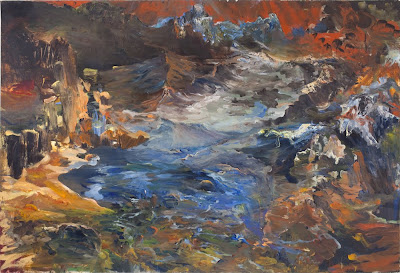

Dorothy Robinson’s paintings have been featured in solo and group exhibitions in museums and galleries, including the Berkeley Art Museum, Williamsburg's Slate Gallery and at Edward Thorp Gallery in Chelsea. She has a studio at the Elizabeth Foundation for the Arts in New York City, and received a Pollock Krasner award in 2008. To learn more about Dorothy, please visit her website.

15 February 2010

10 February 2010

The Sweetest Treat

While the weather outside is cold and blustery. I am keeping my spirits up by keeping busy thinking about art, food, and homemade valentines.

I feel like this cake is an early valentine to me. This picture brings me so much happiness and joy because this was made especially for me by a family friend who has known me since I was 8. Robin used my art announcement as inspiration for the cake which she brought to my art opening on January 16 along with sweet/tart lemon bars and the cutest mini cupcakes on Earth. If that isn't the kindest, most loving thing-- I don't know what is.

So, while the snow keeps me indoors these last few days. I'm thinking of ways to show those special people in my life how much I love them!

06 February 2010

Broken Embraces


This may be the first movie I saw in the theater in 2010. Penelope Cruz is stunning in all of her guises. Read A.O. Scott's review and go see Almodovar's latest!

03 February 2010

Kurt Weiser's gorgeous ceramics at the Society for Contemporary Craft


On a brisk but sunny Saturday afternoon last weekend I was having a food adventure with my friends Andy and Anna in Pittsburgh's Strip District. We popped in to see what was going on at the Society for Contemporary Craft and I was delightfully surprised to discover the beautiful ceramic work of Kurt Weiser.
My favorites were these vessels painted with fine detail and luscious color.

22 November 2009

Spotlight on.....Valerie Hegarty

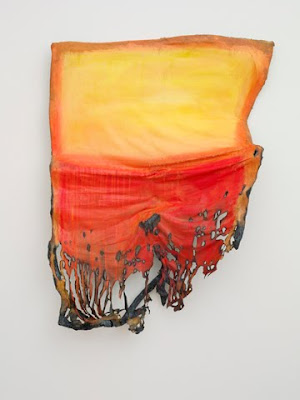
[Rothko Sunset, 2007]

Can you walk me through how a piece comes into being from idea to finished piece.

Let’s see, right now I’m reading “What Painting Is?” by James Elkins and its generating this idea that I want to take various paintings from art history and have them all be melting together, both breaking back down into their chemical makeup, or look like it anyway, then all the color and material mixing together and starting to take a new form, as if the ultimate meaning of the images can be gleaned out by melting and fusing them together. I can’t really picture what this will look like in my head so I’ll usually start with photocopying images from books and cutting and pasting them together and drawing doodles and then the answer might lie more in the process. I can plan which images and how they collide, but I probably won’t come up with the new form it creates until I start working and it starts to form through the process. That is how the work is going these days anyway. Sometimes it’s much more preplanned. Like I had an idea to make a huge early American realist landscape painting being attacked by a woodpecker who was tricked by the realism. But also have it look like machine gunfire blasted the painting from farther away when you see it at first glance and don’t notice the woodpecker. Woodpeckers look for infestations so it implies a level of self-destruction within the American landscape. This was more straight-forward to execute although the process of making the piece added more richness. I got the idea from 2 articles in a newspaper on the same page: there was an article on the war in Iraq and a photo of a tank in Iraq shot through with holes like swiss cheese and below the image was another article on a sighting of a rare woodpecker and it gave me the idea.


[Among the Sierras with Woodpecker, 2005]

How did you arrive at the subject matter of your work?
It’s been a long windy process, that seems to circle around continually, like the snake eating its tail. I’ve always had a strong interest in place, memory, artifact, and make-believe. I grew up in a colonial style house that was built in the late 60s, so we had some faux early American artifacts like a rifle over the fireplace, bedwarmer, Paul Revere tea set and American-ish landscape paintings on the walls, along with framed reproductions of famous paintings that were made to look like real paintings. I loved thinking about these scenes and artifacts as my personal history even though it wasn’t true. My father would always point at the large beams in the ceiling and explain to people how they were cleverly made with many 2x4s stacked together and roughed up so they look just like the original beams would have. I think I hooked onto his delight in the clever copy. We were also never allowed to tack anything to the walls of our bedroom or bend or write on pages in books. I shared a bedroom with my sister and the furniture set was too large for the room so we were packed in there and couldn’t even shut the door. I’d just lie on the bed and imagine writing in all the books and on the walls and breaking the furniture into smaller pieces so we had more room. I think making art and making paintings and breaking them and trying to transform them comes from this strong impulse to touch forbidden things and explore them with a creative passion. To sort of eek out the essence of the materials and meaning. I remember once my sister made a human-like head of Kleenex and glue that looked like a real head and she would carry it around with her on a stick. One day when she left it unattended, our dog attacked it and we found it strewn all over the house and I thought it was brilliant. My father’s a doctor so we would hear about a lot of gory accidents from his reports back from the emergency room so I have a strong sense of the fragility of things and like the rest of my family, I developed a dark sense of humor as a way to cope with the anxiety generated by hearing about bodies falling apart.

[George Washington Shipwrecked, 2007]

How do you decide what materials to work with-- how to turn a 2-d painting into a 3-d sculpture that comes off the wall?
I use materials that are easy for me to manipulate, so they tend to be materials I learned to use as a kid, like cardboard, papermache, tape, wood, wire, glue. Now I’m working on a public project for the Highline that has to be outdoors so I’m working with a fabricator that is translating the work into the best materials for that such as aluminum rod, fiberglass, and epoxy.

What artists, books, or other sources do you look to for ideas and inspiration?

I find inspiration in Magical Realist writers like Octavio Paz and Jose Saramago. How they start the reader off on a totally probably path of the story and somehow when the unbelievable starts to happen, it seems probable. These transitions are beautiful and strange. Oh and I’ve been thinking about Magritte, his way of showing the concealed and the revealed at the same time, these impossible juxtapositions that he makes seem possible and the poetry in the “seaming” together of contrasts. Lately for inspiration I’ve been looking at books on crystals and minerals, bonsai, images of the earth from space, and images of space from the hubble telescope. I also went and looked at the Georgia O’Keefe abstraction show the other day to generate ideas for these abstract forms I want to make based on atmospheric conditions. I’m interested in the sublime in painting and how to transform the 2-d painting into a more abstract form and image, making the transformation of the painting itself a sublime occurrence.

[Niagara Falls, 2007]

Did you always want to be an artist? and how did your career develop when you were first starting out?
I remember when I was really young, I wrote down two career options for myself. One was an artist and one was a writer. I remember practicing my signature on the paper and then putting it away in a drawer. I still think about being a writer. I used to make drawings, paintings, and crafty projects all the time when I was a kid, in addition to writing detective/murder mysteries usually involving ESP. I didn’t really take art in high school because I figured artists must be REALLY good, but in college I took an art class as a lark my junior year and switched my major to studio art much to my parents dismay who were paying my tuition. I then went and did another undergrad in illustration in San Francisco, did that for a bit and didn’t like it and finally went back to graduate school for an MFA at the Art Institute of Chicago. When I graduated I moved to NY and just started applying for everything and was lucky that I got presented many opportunities for free studio space and site-specific installations. I was nominated for a grant and a gallery saw the list of nominees and took an interest in my work. They (Guild & Greyshkul) then offered me a solo show and things went well and we worked together for about 4 years until they closed this past January. Lately I’ve been thinking about wanting to be a writer again and have been writing my own magical realist short stories that tend to veer into the gothic. One story is sort of a retake on Frankenstein, where the artist cuts off her arm in order to have it keep producing in the studio at night while she goes home and sleeps. As you can imagine, things go awry quickly.

What is the most interesting and engaging part about making your work?

I love when I am in the middle of it and things seem to take shape in front of my own eyes, as if someone else was doing it. It’s such an exciting feeling when it seems as if I’m discovering and creating something totally new for myself.

[Unearthed, 2008]

What do you least enjoy about making your work--but you've gotta do it?
Plenty of time the work seems like pure drudgery, once the idea and form is set and there is just straight execution. If I had more money I’d get a team of assistants to do all the labor. And have them clean and organize my studio, it tends to be in disarray most of the time. I also don’t enjoy figuring out and buying materials, packing and shipping work, and trying to keep galleries and curators from figuring out my ideas and work that has changed since we last spoke about the show.

[Valerie in her studio]

What is your studio routine? several project at once? Do you spend time doing research, collecting source materials and ideas?
My studio routine is all over the place. There’s always times when I’m sketching ideas, or looking through and reading books, making models, sleeping, trying to organize the mess I made the day before, talking to whoever is sitting by the refrigerator, picking through the garbage for something I regretted throwing away, etc. There are usually a few projects going on at once and I will work back and forth, trying to give a piece a rest when I can’t seem to figure it out.

What projects are you working on now?
I just finished up some work for a show in Portugal in the spring and finished a public project for the Highline that was installed last week. And I am just about to get started on work for my first solo show at my new gallery in the lower east side, Nicelle Beauchene Gallery.

[Autumn on the Hudson Valley with Branches, installed on the High Line in NYC, 2009]

What do you enjoy doing when you're not in the studio? I like to read Buddhist self-help books, hang out with friends for dinner and coffee, go see shows, see movies, walk around Manhattan and look at the big buildings, visit family in Boston and Maine, and other non-exceptional things. I do some teaching with kids in Brooklyn and just started volunteering at a hospital drawing portraits in pediatrics.


What philosophy or words do you live by? Lately when things get rough, I remember hearing somewhere “most people quit right before they are going to make a breakthrough." And “be grateful everyday."

Valerie has had solo exhibitions at Museum 52 in London, England, the Museum of Contemporary Art Chicago and Guild & Greyshkul Gallery in New York, among others. Her many group exhibitions in New York City include shows at the Brooklyn Museum of Art, Artists Space, The Drawing Center, White Columns and PS1. She is the recipient of awards from the Rema Hort Mann Foundation, the Louis Comfort Tiffany Foundation, and the Illinois Art Council. Additionally, she has participated in residencies at the Marie Walsh Sharpe Space Program, PS 122 Space Program, and Smack Mellon Artist’s Studio Residency, among others. Hegarty holds a MFA from the School of the Art Institute of Chicago, a BFA from San Francisco’s Academy of Art College, and a BA from Middlebury College.

Valerie Hegarty is represented by:
Nicelle Beauchene in NY and Museum 52 in London

View more information on Valerie's installation on the High Line in NYC.

31 October 2009

Process for the brain, eye, and hand: new collages and garden drawings

I am so excited about my work of late! I have been hard at work preparing for my show on November 21st at Imagebox.

My work is going in 2 different but related directions. I've been making brightly colored, abstract, linear collages that morph into organic shapes while also working on a set of colored pencil drawings of lush gardens that grow outside of a mysterious door or gate. These pieces are built up into 3-dimensional layers of paper separated by foam core.

I wonder, what's behind that door? Where is this lush, exotic place? It seems an extension of my interest in Utopian spaces but still relates to the abstract work in terms of color and pattern. It's all very exciting!

I love the multiple step process of creating the intricate drawings and then figuring out how to construct the pop-up parts by cutting into and propping up specific areas. I never know what the finished piece is going to look like; It's a very engaging process for the brain, the eye and the hand.

There is so much that goes into planning an art exhibit- from making the work (the most important part), to marketing it, to finding an exhibit space, to planning the opening celebration details and on and on. My head is spinning.

Spinning in a good way.

30 October 2009

Indian Summer

Dear Blog,
I have been neglecting you. I'm sorry. I've just been so busy with my day jobs and getting new art ready for my art show on November 21st. Suddenly, I'm so busy! I haven't even had time lately to stop in for a lazy cup of coffee at any of my favorite haunts. My days are filled with meetings and task lists and calendars while my nights are filled with art-making and planning --not a bad balance. Unfortunately though, I just don't have a lot of energy left over for thinking up interesting ideas to post or even seeking out artists to interview.

For now dear blog, you might have to go on the back burner. Luckily though, the weather is still lovely as we greet November. I have plenty of wildflowers still growing in the yard with which to decorate the house in pretty bouquets. The leaves are at their crimsony, gold, orange and rich brown peak. Yesterday, D and I went to the pumpkin patch and picked out 2 winners!


This picture just says fall to me: it's a loaf of Challah that I baked myself -- In what little spare time I have-- I like to experiment with recipes!


Here's hoping to a bit more free time to talk to you, blog.
xx, Lauren